
Key Takeaways
- Ephestia kuehniella is the most economically significant stored-product moth in European food distribution, contaminating flour, cereals, dried fruits, and processed goods.
- Warehouse managers must integrate sanitation, temperature management, pheromone monitoring, and targeted treatments to maintain EU Regulation (EC) No 852/2004 compliance.
- Pheromone trapping systems provide early detection well before visible webbing or larval contamination reaches actionable thresholds.
- Professional fumigation or heat treatment should be deployed when monitoring data confirms an established population — consult a licensed pest management provider for structural treatments.
Identification: Recognising Ephestia kuehniella
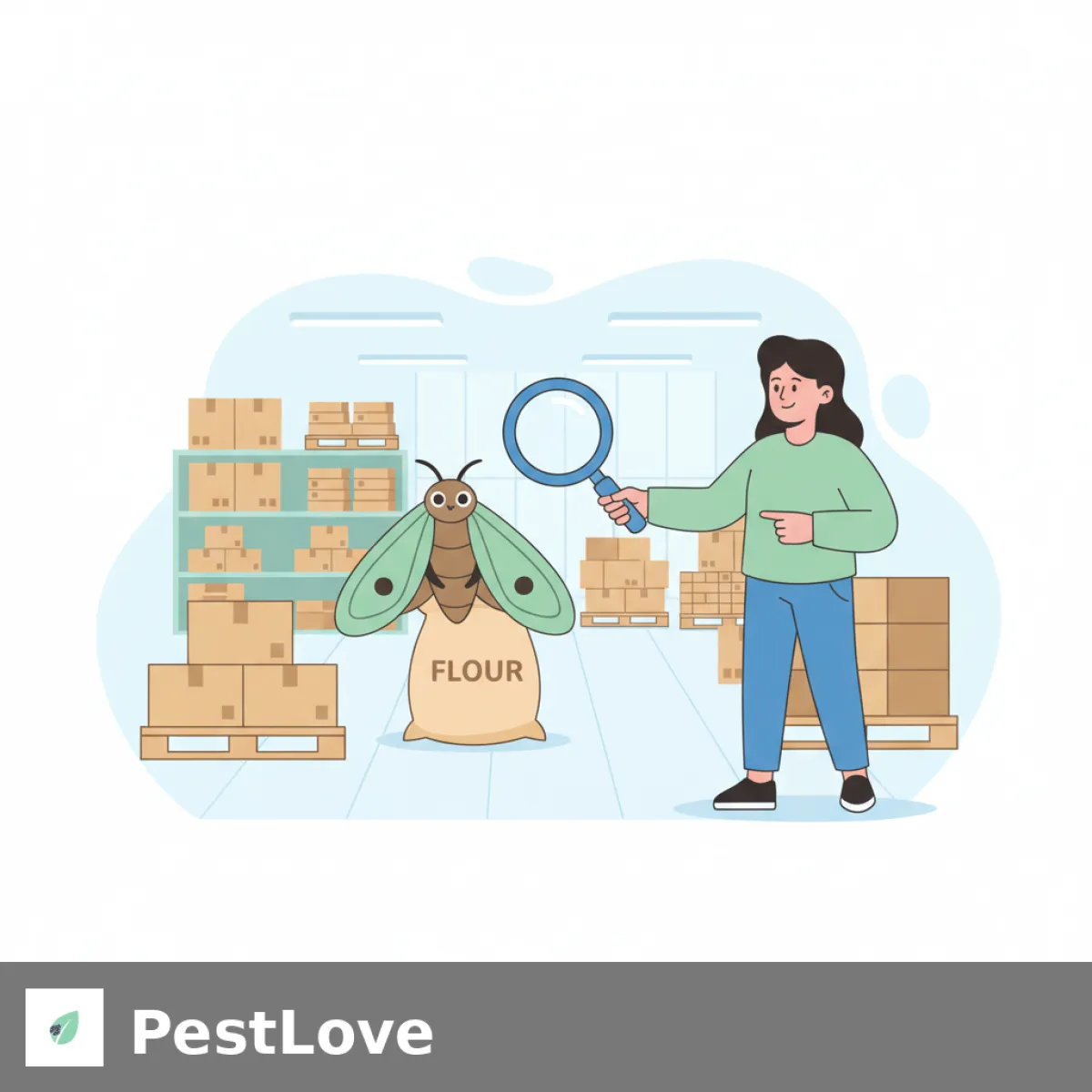
The Mediterranean flour moth (Ephestia kuehniella, Zeller) is a pyralid moth measuring 10–14 mm in wingspan. Adults display pale grey forewings with faint dark zigzag banding and lighter hindwings fringed with fine hairs. At rest, the moth holds its wings in a characteristic roof-like posture close to the body.
Larvae are the damaging stage. Creamy-white caterpillars with darker head capsules grow to approximately 12–15 mm and produce copious silk webbing that binds food particles together. This webbing is often the first visible sign of infestation in warehoused goods, clogging machinery and rendering products unsaleable.
Warehouse staff should distinguish E. kuehniella from the closely related Indian meal moth (Plodia interpunctella), which has a distinctive copper-and-cream bicoloured forewing. Correct identification determines trap type, pheromone lure selection, and treatment protocol.
Biology and Behaviour in Warehouse Environments
Understanding the moth's lifecycle is essential for timing interventions. At typical European warehouse temperatures of 20–25 °C, the full lifecycle — egg, five larval instars, pupa, adult — completes in 8–12 weeks. Females lay 100–350 eggs directly on or near food substrates.
Environmental Drivers
- Temperature: Development accelerates above 20 °C and slows significantly below 15 °C. Warehouses with poor climate control or seasonal temperature spikes face elevated risk during spring and summer.
- Humidity: Relative humidity above 60% favours egg hatch and larval survival. European coastal and riverine distribution hubs are particularly vulnerable.
- Food sources: Flour, semolina, cereals, pasta, dried fruit, nuts, spices, and animal feed all support infestations. Mixed-commodity warehouses face compounded risk from multiple susceptible product lines.
Dispersal Patterns
Adults are weak fliers but readily move between storage bays, loading docks, and adjacent facilities. Infestations frequently originate in incoming shipments — palletised goods from mills, bakeries, or international suppliers may carry eggs or early-instar larvae that escape visual inspection.
Prevention: Warehouse Hygiene and Structural Measures
Prevention forms the foundation of any Integrated Pest Management (IPM) programme. European food distribution operations subject to BRCGS, IFS, or AIB audit standards must demonstrate documented preventive controls.
Sanitation Protocols
- Spillage removal: Sweep and vacuum all spillage from floors, racking, conveyor housings, and loading bay aprons daily. Accumulated flour dust in crevices provides breeding substrate.
- Stock rotation: Enforce strict first-in-first-out (FIFO) protocols. Stagnant inventory beyond 90 days should be flagged for inspection.
- Deep cleaning cycles: Schedule quarterly deep cleans of racking uprights, ceiling voids, cable trays, and wall-floor junctions where larvae pupate in concealed crevices.
Structural Exclusion
- Seal gaps around dock levellers, roller shutter housings, and service penetrations with food-grade sealant or brush strips.
- Install UV-filtered lighting at external doors to reduce adult moth attraction during evening and night operations.
- Fit fine-mesh screens (≤1.6 mm) on ventilation intakes and louvres to prevent adult ingress.
Incoming Goods Inspection
Implement a documented goods-inward inspection protocol. Inspect a statistically valid sample of each delivery for webbing, larvae, adult moths, or characteristic frass. Reject or quarantine non-conforming shipments and notify the supplier. This practice aligns with BRCGS Global Standard for Storage and Distribution requirements and protects downstream customers.
Monitoring: Pheromone Traps and Threshold Management
Delta-style sticky traps baited with the E. kuehniella sex pheromone (Z,E)-9,12-tetradecadienyl acetate provide sensitive, species-specific monitoring. Place traps at a density of one per 200–300 m² of floor area, positioned at 1.5–2 m height on racking uprights or structural columns.
Interpreting Trap Data
- 0–2 moths per trap per week: Background level. Continue routine sanitation and monitoring.
- 3–10 moths per trap per week: Elevated activity. Investigate nearby stock for larval webbing, increase cleaning frequency, and consider localised treatment.
- 10+ moths per trap per week: Established infestation likely. Initiate professional assessment and targeted intervention.
Record all trap counts in a centralised digital pest management log. Trend analysis over 12-month cycles reveals seasonal peaks and helps warehouse managers allocate resources proactively. This documentation is critical during third-party food safety audits.
Treatment Options
Non-Chemical Interventions
- Heat treatment: Raising ambient temperature to 50–55 °C for 24–36 hours kills all life stages. Heat treatment is highly effective in enclosed warehouse zones and leaves no chemical residues — a significant advantage for organic-certified or allergen-sensitive distribution operations.
- Cold treatment: Sustained exposure below −18 °C for 72+ hours is lethal to eggs and larvae. Cold storage areas can exploit existing refrigeration infrastructure for commodity-level treatment.
- Mating disruption: Pheromone dispensers saturate warehouse air with synthetic sex pheromone, preventing males from locating females. Mating disruption works best as a suppression tool in low-to-moderate infestations alongside sanitation improvements.
Chemical Interventions
- Residual surface sprays: Pyrethroid or organophosphate formulations applied to racking bases, wall-floor junctions, and structural harbourage points. Product selection must comply with EU Biocidal Products Regulation (BPR, Regulation (EU) No 528/2012) and national authorisation requirements.
- Fumigation: Phosphine (aluminium phosphide) fumigation under gas-tight sheeting or in sealed chambers remains the standard for treating large volumes of infested commodity. Fumigation must be conducted by licensed, certified operators and requires documented exposure periods (typically 120+ hours at ≥15 °C) and gas-free clearance testing before re-entry.
- ULV fogging: Ultra-low-volume applications of pyrethrin or synthetic pyrethroid provide knockdown of flying adults but do not penetrate commodity packaging. ULV fogging serves as a supplementary measure, not a standalone solution.
For operations handling products destined for organic or sensitive markets, non-chemical methods should be prioritised. Chemical treatments must always be applied in accordance with label directions and documented in the facility's pest management file. Consult the GFSI pest control audit checklist for documentation standards.
When to Call a Professional
Warehouse managers should engage a licensed pest management professional when:
- Pheromone trap counts consistently exceed action thresholds (10+ moths per trap per week) despite intensified cleaning.
- Larval webbing is found in multiple storage zones or on product packaging.
- A customer complaint or audit non-conformance is linked to moth contamination.
- Fumigation, structural heat treatment, or regulated biocide application is required — these interventions demand specialist equipment, safety protocols, and legal certification.
- The infestation persists through two or more treatment cycles, suggesting harbourage in concealed structural voids.
A qualified pest management provider will conduct a thorough site survey, identify harbourage points through targeted inspection and possibly larval sampling, and design a treatment programme integrated with the warehouse's food safety management system.
Regulatory and Audit Considerations for European Warehouses
European food distribution warehouses operate under a layered regulatory framework. EU Regulation (EC) No 852/2004 on the hygiene of foodstuffs requires operators to implement pest control as part of prerequisite programmes. Third-party certification schemes — including BRCGS, IFS, and FSSC 22000 — impose more detailed requirements, including documented pest risk assessments, monitoring maps, trend analysis, and corrective action records.
Non-compliance with pest control standards can result in critical audit findings, product recalls, loss of certification, and reputational damage across the supply chain. Warehouse operators managing flour, cereal, and dried-goods logistics should treat moth management as a core element of due diligence — not an afterthought.
Building a Long-Term IPM Programme
Sustainable Mediterranean flour moth control depends on integrating all available tools into a coherent programme:
- Assess risk: Map susceptible commodities, environmental conditions, and historical pest data across the facility.
- Prevent: Enforce sanitation standards, structural exclusion, and incoming-goods inspection as non-negotiable baselines.
- Monitor: Deploy pheromone traps at appropriate density and review data weekly.
- Intervene: Apply proportionate treatments — non-chemical first where feasible, chemical where necessary — based on monitoring thresholds.
- Review: Conduct quarterly programme reviews with the pest management provider, adjusting trap placement, cleaning schedules, and treatment strategies based on trend data.
Warehouses that also manage rodent exclusion and stored-product beetle control should integrate moth monitoring into a unified IPM dashboard to streamline audits and resource allocation.
