
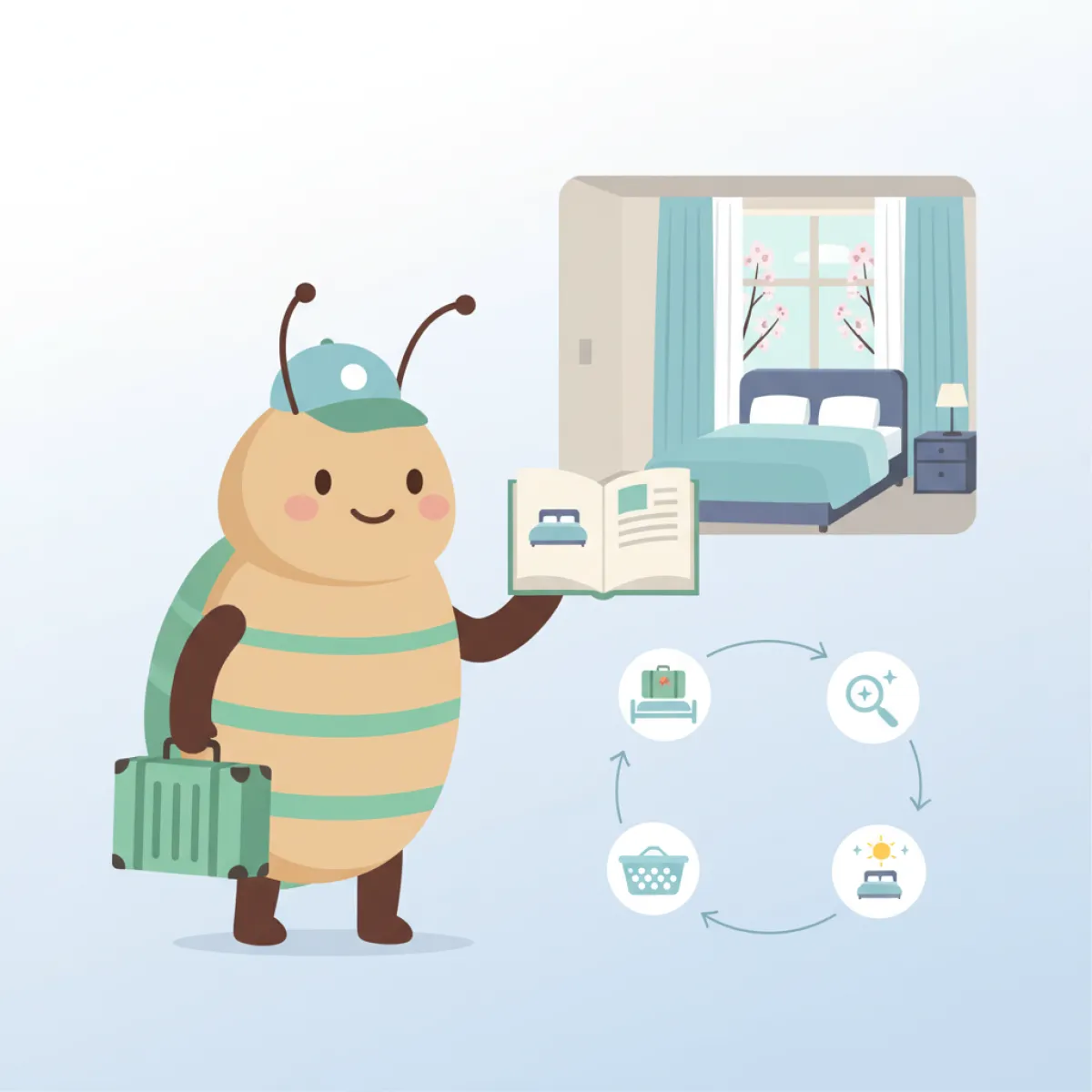
Key Takeaways for Busy Hoteliers
- Proactive Inspection: Train housekeeping to inspect 'hot zones' (headboards, mattress seams) during every turnover.
- Staff Empowerment: Create a 'no-shame' reporting culture where staff are rewarded for finding pests early.
- Isolation is Key: Move guests immediately and take the room (plus adjacent ones) out of service if a sighting occurs.
- Professional Partnership: Boutique aesthetics require surgical precision; avoid DIY chemicals that cause scatter.
The Biology of the Spring Break Hitchhiker
In my 20 years of pest control experience, I’ve seen how the surge of Spring Break travel creates a 'perfect storm' for Cimex lectularius, the common bed bug. Unlike many other pests, bed bugs do not discriminate based on the cleanliness of a property. They are strictly 'hitchhikers,' transported via luggage, clothing, and even public transit. During Spring Break, the high frequency of guest turnover in boutique hotels significantly increases the statistical likelihood of an introduction.
Bed bugs are nocturnal, thigmotactic (they prefer tight spaces), and attracted to the carbon dioxide and heat emitted by sleeping humans. They can survive for months without a blood meal by entering a state of diapause, meaning a room that has been vacant for a week is not necessarily 'safe.' For a boutique hotel, where a single negative review regarding 'bugs' can devastate a curated reputation, prevention is not just a maintenance task—it is a core business strategy.
Early Detection: Signs Your Staff Must Never Ignore
Detection is the first line of defense. In the field, I often see infestations that could have been stopped weeks earlier if housekeeping knew what to look for beyond the live insect. Professionals look for 'traces' rather than the bugs themselves:
- Fecal Spotting: Small, dark, circular spots (digested blood) that look like a felt-tip pen mark on sheets, pillowcases, or mattress seams.
- Exuviae (Shed Skins): As bed bugs grow, they molt five times. These translucent, amber-colored casings are often found in the crevices of headboards.
- Blood Smears: Small, rusty streaks on linens caused by a guest accidentally crushing a recently fed bug.
- The Odor: In larger infestations, a sweet, musty 'coriander' or 'wet almond' scent may be present, though this is rare in early-stage introductions.
The "Spring Break Shield": Proactive Prevention Protocols
Boutique hotels often feature unique furniture, such as tufted headboards and antique frames, which provide more hiding spots than standard hotel furniture. Implementing a "Spring Break Shield" protocol is essential during high-traffic months.
1. Enhanced Housekeeping Training
Your housekeeping team is your most valuable asset. During Spring Break, implement a 2-minute 'Quick Peek' protocol for every room change. This involves pulling back the fitted sheet at the head of the bed to inspect the mattress piping and checking the space behind the headboard using a high-lumen flashlight. For more detailed standards, refer to our [Professional Bed Bug Prevention: Hospitality Standards for Boutique Hotels and Airbnb Hosts](/en/guides/professional-bed-bug-prevention-hospitality-standards-for-boutique-hotels-and-airbnb-hosts).
2. Luggage Management for Guests
Bed bugs almost always enter a room via luggage. Encourage guests to use metal luggage racks. Bed bugs find it difficult to climb smooth, cold metal surfaces compared to wood or fabric. If your boutique aesthetic allows, provide stylish, polished chrome racks in every room.
3. Protective Encasements
Use high-quality, laboratory-tested mattress and box spring encasements. These serve two purposes: they prevent bed bugs from entering the complex interior of the mattress (making them easier to spot on the surface) and they 'save' your investment by preventing the need to discard expensive mattresses if an infestation occurs.
Integrated Pest Management (IPM) in a Boutique Setting
Integrated Pest Management (IPM) is the gold standard in professional pest control. It focuses on long-term prevention and minimal chemical usage—critical for boutique hotels that pride themselves on a 'home-away-from-home' feel without the smell of pesticides.
IPM involves the use of Active Monitors and Passive Interceptors. Passive interceptors are small plastic dishes placed under the legs of beds. They have a smooth outer well that bugs can climb into but cannot climb out of. Checking these weekly provides an early warning system that is 100% discreet from the guest's perspective.
Handling a Guest Report: The "No-Panic" Protocol
How you handle a complaint is more important than the presence of the bug itself. In the age of social media, a handled complaint stays private; a mishandled one goes viral.
- Relocate Immediately: Move the guest to a different floor, if possible, but do not move their luggage until it has been inspected or treated (to avoid spreading the bugs to the new room).
- Isolation: Take the reported room out of service. Crucially, also take the rooms directly above, below, and adjacent (the 'cloverleaf' pattern) out of service until they are inspected by a professional. Bed bugs can easily travel through wall voids and electrical outlets.
- Professional Documentation: Always have a certified professional confirm the sighting. If it turns out to be a 'false alarm' (like a beetle or lint), you have a professional report to protect your hotel against refund scams.
Professional Remediation: Why DIY is a Liability
I cannot stress this enough: Do not allow your maintenance staff to use 'bug bombs' or over-the-counter sprays. In my experience, these products are repellent. They don't kill the entire colony; instead, they cause the bed bugs to 'scatter' deeper into the walls and into neighboring rooms, turning a $500 problem into a $10,000 multi-room nightmare.
Professional treatments usually involve Whole-Room Heat Treatments (raising the temperature to 122°F/50°C for several hours) or targeted Cryonite (CO2) treatments, combined with non-repellent residuals. For boutique hotels, heat is often preferred as it is chemical-free and allows the room to be returned to service much faster.
When to Call a Professional
In the hospitality industry, the threshold for calling a professional is a single confirmed sighting or two 'suspected' sightings. If a guest shows you bites, or if a housekeeper finds a single live insect, you must engage a certified entomologist or pest professional immediately. Early intervention is the only way to prevent a localized introduction from becoming a building-wide infestation.
While bed bugs are the primary concern for guest rooms, don't forget the 'back of house.' For those with on-site dining, maintaining high standards is equally vital. See our guide on [German Cockroach Elimination in Commercial Kitchens](/en/guides/german-cockroach-elimination-in-commercial-kitchens-passing-your-spring-health-inspection) to ensure your spring health inspection is as spotless as your guest rooms.