
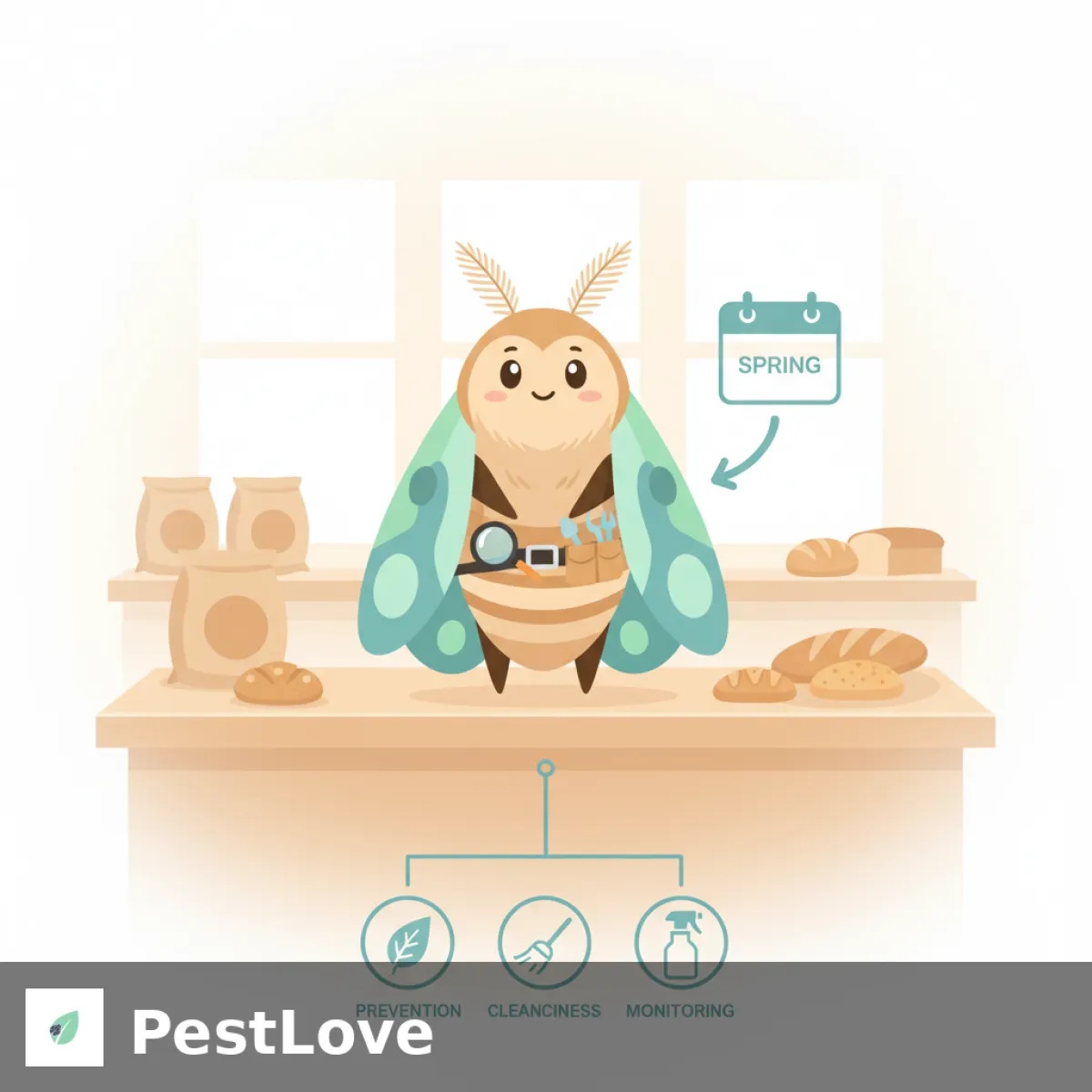
Key Takeaways
- Plodia interpunctella activity spikes in spring when ambient temperatures consistently exceed 15°C (59°F), making March through May a critical monitoring window for bakeries and food warehouses.
- Pheromone traps should be deployed at a density of one trap per 200 square metres across all storage and production zones.
- Sanitation and stock rotation are the most cost-effective first lines of defence — chemical treatments should supplement, not replace, hygiene protocols.
- Failing to control Indian meal moth populations can trigger audit non-conformances under GFSI-benchmarked standards (BRC, SQF, FSSC 22000) and result in costly product recalls.
- A licensed pest management professional should be engaged for fumigation, insect growth regulator (IGR) application, or any infestation affecting more than two zones simultaneously.
Identification: Recognising Plodia interpunctella
The Indian meal moth (Plodia interpunctella) is the most economically significant stored-product moth worldwide. Adults measure 8–10 mm in length and are readily identified by their distinctive two-toned forewings: the proximal third is pale grey or cream, while the distal two-thirds display a coppery-bronze hue with dark banding. At rest, the wings fold closely over the body, giving the moth a narrow, elongated profile.
Larvae are the destructive life stage. Creamy-white caterpillars, sometimes tinged pink or green depending on diet, grow to approximately 12 mm. They produce conspicuous silken webbing that binds food particles together — a hallmark sign of infestation in flour bins, grain hoppers, and finished-product packaging. Frass (faecal pellets) and cast larval skins accumulate near feeding sites.
Facility managers should not confuse Indian meal moths with the Mediterranean flour moth (Ephestia kuehniella), which is uniformly grey and tends to inhabit milling equipment. Correct identification is essential because trap lure chemistry and treatment thresholds differ between species.
Biology and Spring Behaviour
Indian meal moths are highly temperature-dependent. Development from egg to adult takes roughly 28–35 days at 28–30°C but can extend to 300 days in cool storage. As spring temperatures warm bakery attics, loading docks, and warehouse rooflines, overwintering pupae complete development and adults emerge in significant numbers.
Key biological facts relevant to spring IPM planning:
- Egg stage: Females lay 100–400 eggs directly on or near food sources. Eggs hatch in 2–14 days depending on temperature.
- Larval stage: Five to seven instars over 14–40 days. Larvae are mobile and may travel several metres from the food source to pupate in cracks, ceiling joints, or behind wall panels.
- Pupal stage: Pupation occurs in silken cocoons spun in harbourage sites away from food — making pupae difficult to reach with contact insecticides.
- Adult stage: Adults live 5–13 days and do not feed. Their sole purpose is reproduction. Adults are weak fliers but are strongly attracted to light, often appearing near windows and luminaires.
In bakeries, the warm, flour-rich environment can sustain year-round populations, but spring marks a pronounced emergence peak that coincides with increased production schedules and incoming raw-ingredient shipments — both of which amplify infestation risk.
Why Bakeries and Food Warehouses Are Vulnerable
Several operational characteristics make bakeries and food warehouses particularly susceptible to spring Indian meal moth surges:
- Abundant food sources: Flour, sugar, dried fruit, nuts, chocolate chips, spice blends, and grain-based mixes provide ideal larval nutrition.
- Temperature gradients: Ovens, proofing rooms, and warm ceilings create microclimates that accelerate moth development even when ambient warehouse temperatures are moderate.
- Complex structures: Dropped ceilings, cable trays, mezzanine floors, and racking systems offer countless pupation harbourages that are difficult to inspect and clean.
- Incoming goods risk: Raw ingredients may arrive pre-infested with eggs or early-instar larvae that are invisible to the naked eye.
For warehouses managing both food and non-food inventory, cross-contamination zones — where pallets are staged near loading docks — represent high-risk areas. Similar vulnerabilities exist in organic food warehouses where fumigant options are restricted.
Spring Monitoring Protocol
Pheromone Trap Deployment
Delta-style pheromone traps baited with Z,E-9,12-tetradecadienyl acetate (the primary female sex pheromone component) are the cornerstone of an Indian meal moth monitoring programme. Deploy traps according to these guidelines:
- Place one trap per 200 m² of floor area, at a height of 1.5–2 m, ideally near walls and ingredient storage zones.
- Avoid placing traps directly above open product or within 3 m of competing light sources, which reduce trap efficacy.
- Replace lures every 4–6 weeks; replace sticky inserts when more than 50% of the surface is covered.
- Record trap counts weekly. A threshold of 2–3 moths per trap per week in any single zone should trigger an investigation; counts exceeding 10 per trap per week indicate active infestation requiring immediate intervention.
Visual Inspections
Supplement trapping with structured visual inspections every two weeks during spring. Inspect:
- Tops of racking and shelving, where larvae migrate to pupate.
- Ceiling-wall junctions, light fittings, and cable conduit entry points.
- Incoming raw materials — open at least 5% of cartons per delivery and check for webbing or larvae.
- Packaging seams and corrugated cardboard folds, which harbour eggs.
Prevention: Sanitation and Exclusion
Sanitation is the single most important pillar of Indian meal moth IPM. Without removing food sources, no chemical programme will deliver lasting results.
Cleaning Protocols
- Vacuum all spillage from floors, racking ledges, and equipment bases daily. Use HEPA-filtered vacuums in production areas.
- Conduct deep cleans of storage areas on a rotating monthly schedule, moving stock to access wall bases and floor drains.
- Remove and dispose of accumulated dust from overhead structures, cable trays, and ventilation grilles — these often contain enough organic residue to sustain larvae.
- Clean ingredient bins between refills. Never top up fresh stock onto old product without cleaning the container.
Stock Rotation and Incoming Goods Management
- Enforce strict FIFO (first in, first out) rotation. Product dwelling beyond 30 days in ambient storage should be inspected before use.
- Quarantine incoming dry goods in a designated receiving bay for 48 hours and inspect before transferring to main storage.
- Where feasible, transfer bulk ingredients from supplier packaging into sealed, food-grade containers with tight-fitting lids.
Structural Exclusion
- Seal gaps around pipe penetrations, cable entries, and expansion joints with food-safe sealant.
- Install or repair door seals and strip curtains on loading-dock doors. Indian meal moth adults readily enter through open dock bays at dusk.
- Fit UV insect light traps (ILTs) near entry points and in corridors connecting storage to production — these intercept flying adults before they reach product zones. Position ILTs so they are not visible from outside, which would attract additional insects inward.
These same exclusion principles apply to broader facility pest-proofing and should be integrated into a unified perimeter-defence programme.
Treatment Options
Non-Chemical Methods
- Cold treatment: Holding infested or suspect ingredients at −18°C for 7 days kills all life stages. This is practical for warehouses with dedicated freezer capacity.
- Heat treatment: Raising the ambient temperature of an enclosed space to 50–60°C for 24 hours eliminates all life stages, including pupae in harbourages. Heat treatment requires professional equipment and monitoring to ensure uniform temperature distribution.
- Mating disruption: Aerosol or passive dispensers release synthetic pheromone at high concentrations, confusing males and preventing successful mating. Mating disruption is most effective as a suppression tool when populations are moderate and sanitation is maintained.
Chemical Methods
- Residual surface sprays: Pyrethroid-based products (e.g., deltamethrin, cyfluthrin) applied to non-food-contact surfaces — racking uprights, wall-floor junctions, and structural crevices — provide knockdown of crawling larvae. Always follow label directions and local regulations.
- Insect growth regulators (IGRs): Methoprene and hydroprene mimic juvenile hormones, preventing larvae from completing development. IGRs offer extended residual activity and are considered reduced-risk by the EPA.
- Fumigation: Phosphine (aluminium phosphide) fumigation is effective for severe infestations in sealed warehouse spaces. Fumigation must be conducted by licensed applicators and requires facility evacuation. It is typically a last resort after sanitation and targeted treatments have failed.
All chemical applications in food facilities must comply with local pesticide regulations and should be documented in the facility's pest control logbook for audit readiness. For guidance on audit documentation, see GFSI pest control audit preparation.
When to Call a Professional
Facility managers should engage a licensed pest management professional when:
- Pheromone trap counts exceed 10 moths per trap per week in any zone for two consecutive weeks.
- Webbing or larvae are found in finished product or primary packaging — indicating the infestation has breached production-area controls.
- Multiple zones show simultaneous activity, suggesting a facility-wide population rather than a localised pocket.
- Fumigation, heat treatment, or IGR application is required — these are specialised interventions that demand professional equipment, licensing, and safety protocols.
- A third-party food safety audit is approaching and trap trend data shows an upward trajectory.
Professional pest controllers can also conduct species-level identification, assess structural harbourage risks, and design a site-specific treatment rotation to prevent resistance development.
Regulatory and Audit Considerations
Indian meal moth findings are among the most common pest-related non-conformances in food safety audits. Under BRC Global Standard for Food Safety, SQF, and FSSC 22000, auditors expect to see:
- A documented pest monitoring programme with trap maps, inspection schedules, and action thresholds.
- Trend analysis of trap data demonstrating that corrective actions are effective.
- Evidence that incoming goods are inspected and that supplier pest-management expectations are communicated.
- Proof that chemical treatments are applied by qualified personnel using approved products, with safety data sheets on file.
Failing to demonstrate control of stored-product moths can result in minor or major non-conformances, conditional certification, or — in severe cases — suspension of the site's food safety certificate. The financial consequences, including product holds, customer complaints, and retailer delistings, far outweigh the cost of a robust spring IPM programme.
