
Key Takeaways
- Trogoderma granarium is classified as one of the world's 100 worst invasive species and is a quarantine-actionable pest in the United States, Australia, and the European Union.
- Larvae can survive in diapause for years without food, making eradication from warehouse infrastructure exceptionally difficult once established.
- Effective port warehouse programs combine pheromone trapping, visual inspection of incoming cargo, heat treatment, and methyl bromide or phosphine fumigation under regulatory oversight.
- A single confirmed interception can trigger facility-wide quarantine, shipment rejection, and costly trade disruptions—prevention is far more economical than remediation.
Identification: Recognizing Trogoderma granarium
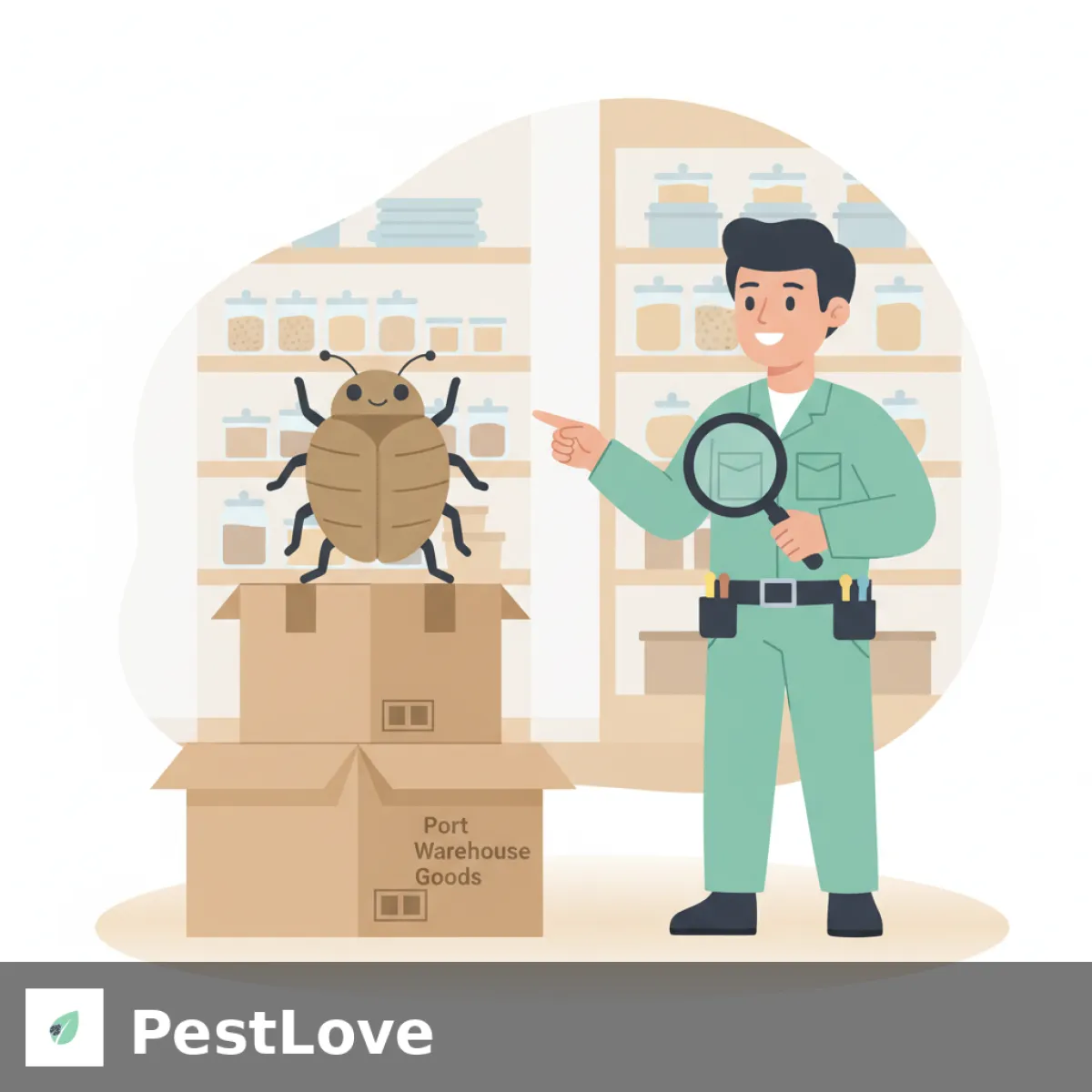
The khapra beetle (Trogoderma granarium Everts) belongs to the family Dermestidae. Adults are small, oval beetles measuring 1.6–3.0 mm in length, with mottled brown elytra bearing faint, lighter transverse bands. Males tend to be smaller and darker than females. However, adult beetles are relatively short-lived and infrequently encountered during inspections; the larval stage causes the vast majority of commodity damage.
Larvae are densely covered in characteristic barbed setae (hairs) and grow to approximately 5–6 mm at maturity. Their coloration ranges from yellowish-brown to dark reddish-brown, with distinct banding across body segments. Cast larval skins—often found in dense accumulations along wall-floor junctions, inside crevices, and within commodity packaging—are a primary diagnostic indicator during warehouse surveys.
Unlike many stored-product beetles, khapra beetle larvae enter a state of facultative diapause when conditions become unfavorable. Diapausing larvae can survive without food for two to three years, retreating deep into structural cracks, beneath insulation panels, inside corrugated packaging, and within expansion joints. This biological trait is what makes the species so difficult to eradicate from infested warehouse environments and so dangerous as an invasive threat at international ports.
Behavior and Biology Relevant to Port Warehouses
Khapra beetle thrives in hot, dry climates—optimal development occurs between 33–37 °C with relative humidity below 40%. Port warehouses in the Middle East, South Asia, North Africa, and Mediterranean regions face the highest ambient risk profiles. However, heated warehouses in temperate trade hubs such as Rotterdam, Hamburg, Los Angeles, and Melbourne also provide suitable microclimates, particularly near heating ducts, sun-facing walls, and roof spaces.
The beetle feeds on a broad range of dried plant products: wheat, rice, barley, maize, oilseeds, dried fruits, pulses, spices, and animal feed. Larvae preferentially consume the germ and endosperm of grain kernels, producing large quantities of frass and cast skins that contaminate commodities well beyond the volume actually consumed. Infested grain may be reduced to powder-like residue.
Critically, khapra beetle does not fly under most warehouse conditions. Spread within and between facilities is almost entirely passive—via infested commodities, shipping containers, pallets, dunnage, and packaging materials. This passive dispersal pathway is precisely why border interception and import warehouse vigilance are the frontline defenses against establishment in non-endemic countries.
Detection Methods for Import Warehouses
Pheromone Trapping Programs
Pheromone-baited sticky traps using synthetic Trogoderma aggregation pheromones are the cornerstone of khapra beetle monitoring in port-adjacent warehouses. Traps should be deployed at a density of one trap per 200–300 m² of floor area, positioned along perimeter walls, near roller doors, adjacent to commodity storage zones, and at dock-level receiving areas. Traps require inspection and replacement on a 14-day cycle, with all captured dermestid specimens retained for expert taxonomic identification—several native Trogoderma species resemble T. granarium and must be differentiated by a trained entomologist or through molecular (PCR-based) confirmation.
Visual Inspection Protocols
Incoming shipments from high-risk origin countries—particularly those on USDA APHIS, EPPO, or Australian BICON alert lists—should undergo systematic visual inspection before being accepted into general warehouse storage. Inspectors should examine:
- Bag seams, stitching channels, and the inner surfaces of bulk container liners for live larvae, cast skins, or frass accumulation.
- Container floor joints, door gasket channels, and corrugation ridges for diapausing larvae.
- Pallet bases and dunnage timber for larval harborage in cracks and nail holes.
- Commodity samples drawn from the top, middle, and bottom of each consignment using a grain trier or sampling spear.
Commodity Sampling and Laboratory Analysis
For bulk grain and oilseed shipments, sampling should follow international grain shipment pest prevention protocols. Composite samples should be sieved over a 2 mm mesh to concentrate insects, skins, and frass. Any suspect dermestid specimens should be submitted to an accredited diagnostic laboratory. Molecular identification using cytochrome oxidase I (COI) barcoding provides definitive species-level confirmation within 24–48 hours.
Quarantine and Response Protocols
Immediate Containment
Upon confirmed or suspected detection of T. granarium, the following containment steps should be initiated immediately:
- Isolate the consignment. Seal the affected container or pallet lot in situ. Do not move infested goods to other warehouse zones.
- Notify the national plant protection organization (NPPO). In the United States, this is USDA APHIS PPQ; in Australia, the Department of Agriculture; in the EU, the relevant Member State NPPO under EPPO protocols.
- Restrict personnel movement. Limit access to the affected zone to prevent passive dispersal of larvae on clothing, footwear, or equipment.
- Document the detection. Photograph all evidence, record lot numbers, container IDs, vessel name, port of origin, and consignment documentation for traceability.
Fumigation and Treatment Options
Regulatory authorities typically mandate one of the following treatments for confirmed khapra beetle interceptions:
- Methyl bromide fumigation at prescribed dosage rates (commonly 48 g/m³ for 24 hours at ≥21 °C under gas-tight tarps or in approved chambers). Methyl bromide remains the benchmark quarantine treatment despite Montreal Protocol phase-down provisions, as quarantine and pre-shipment (QPS) uses retain exemptions.
- Phosphine fumigation using aluminum or magnesium phosphide at label rates, with exposure periods of 5–7 days depending on temperature. Phosphine is effective but requires longer exposure and strict gas-tightness.
- Heat treatment at a core commodity temperature of ≥60 °C maintained for a minimum of 6 hours. Heat treatment is effective against all life stages, including diapausing larvae, and leaves no chemical residues—making it preferred for organic or food-grade commodities.
Re-export or destruction of the consignment may be ordered if treatment is not feasible or if the infestation is deemed too severe for remediation. Warehouse managers should maintain pre-negotiated contracts with licensed fumigation providers experienced in quarantine-grade treatments to minimize response delays.
Structural Decontamination
If larvae have dispersed into warehouse infrastructure—wall cavities, expansion joints, beneath floor plates, or inside insulation—structural fumigation of the affected warehouse zone may be required. Diapausing larvae embedded in cracks are notoriously resistant to surface-applied residual insecticides. Structural treatments typically involve full-space methyl bromide or heat remediation, conducted under regulatory supervision. Facility managers should be aware that structural decontamination can require warehouse closure for days to weeks, with significant revenue impact. Detailed guidance on warehouse pest exclusion is available in the automated warehouse pest exclusion standards guide.
Prevention: Integrated Pest Management for Port Warehouses
Supplier and Origin Screening
Effective prevention begins upstream. Warehouse operators receiving international commodities should require phytosanitary certificates from origin-country NPPOs and maintain an internal risk register that flags consignments from countries where T. granarium is established. High-risk origins include (but are not limited to) India, Pakistan, Bangladesh, Iraq, Iran, Egypt, and several sub-Saharan African nations.
Sanitation and Structural Maintenance
Khapra beetle establishment in warehouses is facilitated by residual commodity dust, spilled grain, and structural harborage. IPM programs should include:
- Weekly vacuuming of floor-wall junctions, pallet racking bases, and conveyor housings to remove commodity residues.
- Sealing of expansion joints, cable penetrations, and wall cracks with food-grade silicone or polyurethane sealant.
- Prompt removal of empty bags, dunnage, and packaging materials from receiving areas.
- Rotation of stock on a strict first-in, first-out (FIFO) basis to prevent long-term commodity storage that favors population buildup.
Sanitation standards for stored-product environments are discussed further in the GFSI pest control audit preparation checklist.
Temperature and Environmental Controls
Where feasible, maintaining warehouse temperatures below 25 °C significantly slows khapra beetle development. Cooled or air-conditioned storage sections for high-value or high-risk commodities reduce reproductive rates and discourage larval activity. Monitoring warehouse temperature and humidity with networked data loggers provides early warning of microclimate conditions favorable to pest development.
When to Call a Professional
Any suspected detection of khapra beetle in a port warehouse constitutes a regulatory emergency. Warehouse managers should not attempt self-diagnosis or in-house treatment. Instead, the following professional resources should be engaged immediately:
- A certified pest management professional (PMP) with stored-product pest expertise and quarantine fumigation licensing.
- An accredited entomological diagnostic laboratory for species confirmation via morphological and molecular analysis.
- The relevant NPPO or border biosecurity agency for official notification and regulatory guidance on hold orders, treatment mandates, and release procedures.
Failure to report a khapra beetle detection can result in severe regulatory penalties, loss of import privileges, and—in extreme cases—criminal prosecution under biosecurity legislation. The costs of proactive monitoring and professional partnerships are negligible compared to the trade disruptions, commodity losses, and facility closures associated with an uncontrolled establishment event.
