
Key Takeaways
- Trogoderma granarium (khapra beetle) is classified as a quarantine pest by USDA APHIS, EPPO, and most national plant protection organizations due to its capacity to devastate stored grain, seeds, and dried commodities.
- Larvae can enter diapause for years, surviving without food in cracks, wall voids, and structural joints — making eradication from warehouse environments extremely difficult.
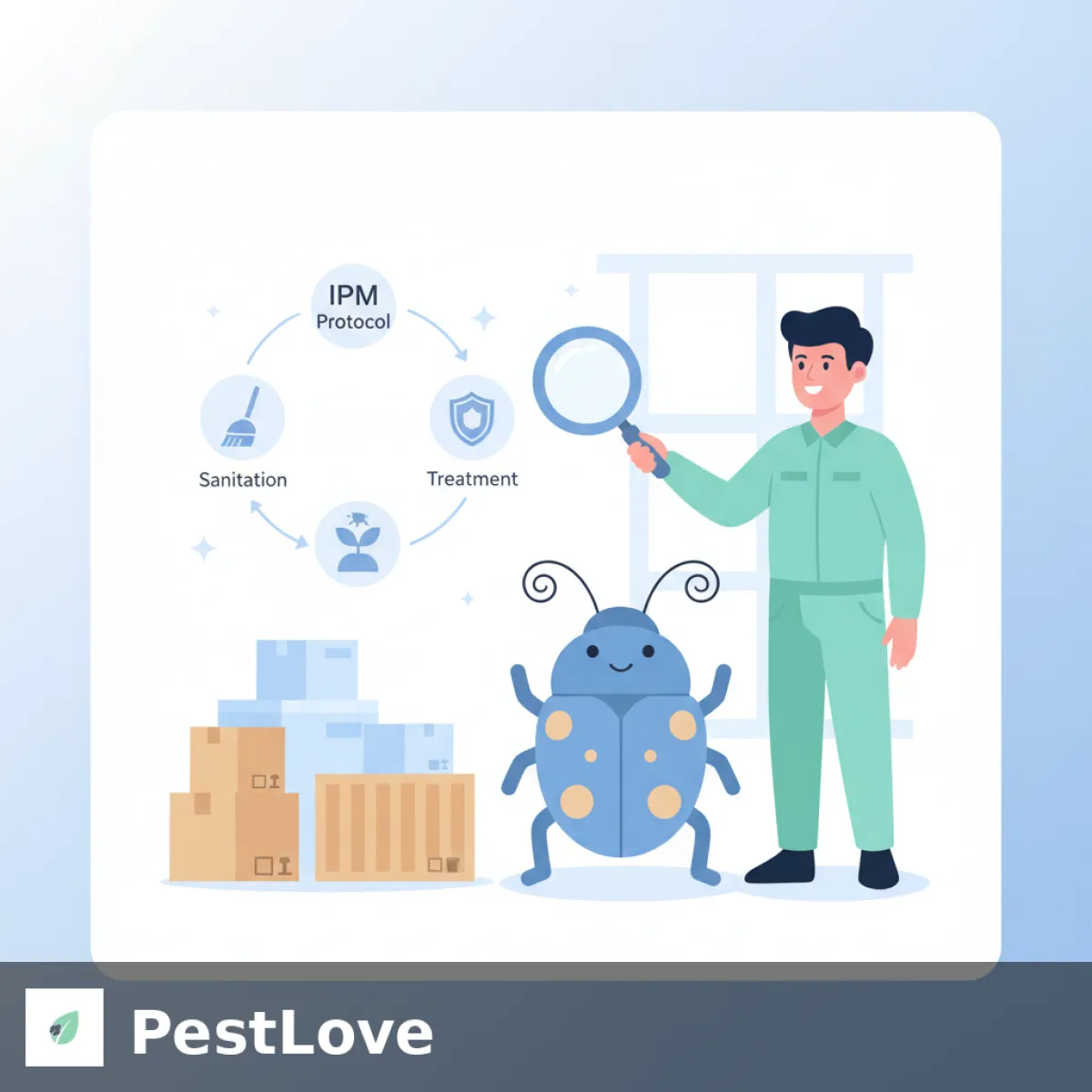
- Effective port-warehouse IPM combines rigorous inspection, pheromone monitoring, heat or fumigation treatments, and strict sanitation protocols.
- A confirmed detection typically triggers mandatory quarantine, regulatory holds, and cargo rejection or treatment under international phytosanitary frameworks (ISPM 15, ISPM 28).
- Warehouse managers should maintain documented pest management programs to satisfy audit requirements from GFSI-benchmarked certification schemes.
Identification: Recognizing Trogoderma granarium
The khapra beetle (Trogoderma granarium Everts) is a small dermestid beetle measuring 1.6–3.0 mm in length. Adults are oval, brown to dark brown, and covered in fine setae. However, it is the larval stage that causes nearly all commodity damage. Larvae are yellowish-brown, densely hairy, and possess characteristic hastisetae — barbed, arrow-shaped hairs that contaminate grain and can cause allergic reactions in handlers.
Accurate identification is critical because khapra beetle larvae closely resemble other Trogoderma species and warehouse dermestids. Molecular diagnostics (PCR-based) or examination of male genitalia by a trained entomologist are often required for species-level confirmation. Port warehouse staff should never attempt final identification independently — suspect specimens must be forwarded to the national plant protection organization (NPPO) or an accredited diagnostic laboratory.
Commodities at Risk
Khapra beetle infests a broad range of dried commodities, including wheat, rice, barley, maize, sorghum, oilseeds, dried fruits, spices, and animal feed. Import warehouses handling bulk grain shipments, spice consignments, and dried food products at trade ports face elevated risk, particularly when receiving cargo from regions in South Asia, the Middle East, and North Africa where the pest is established.
Biology and Behavior: Why Khapra Beetle Is So Dangerous
Several biological traits make T. granarium uniquely difficult to manage in warehouse environments:
- Facultative diapause: When conditions become unfavorable — low humidity, food scarcity, or disturbance — larvae enter a dormant state that can persist for two to four years or longer. Diapausing larvae retreat deep into structural crevices, making them invisible to routine visual inspection.
- Extreme heat tolerance: Unlike many stored-product insects, khapra beetle larvae tolerate temperatures exceeding 40 °C and thrive in hot, dry climates characteristic of many major port cities.
- Low moisture requirement: Larvae can survive in commodities with moisture content as low as 2%, far below the threshold that limits most competing species.
- Rapid population growth: Under optimal conditions (33–37 °C, 25–40% RH), a single generation can complete in as few as 26 days, enabling explosive population increases within a shipping container or warehouse bay.
- Contamination severity: Heavy infestations render entire grain lots unsuitable for human consumption due to larval cast skins, hastisetae, and frass. Commodity losses of 30% or more are documented in unmanaged storage scenarios.
Detection Protocols for Import Warehouses
1. Pre-Arrival Risk Assessment
Before cargo reaches the warehouse, managers should evaluate risk based on:
- Country of origin and its khapra beetle status (refer to EPPO or CABI pest distribution databases).
- Commodity type and packaging integrity.
- Shipping container condition — age, cleanliness, and prior cargo history.
- Accompanying phytosanitary certificates and treatment declarations.
2. Physical Inspection at Intake
All high-risk consignments should undergo thorough inspection upon arrival:
- Sample grain or product from multiple depths and locations within the container or pallet stack — larvae concentrate in warm, sheltered micro-environments near walls and seams.
- Inspect container door gaskets, floor joints, corrugation channels, and ceiling rails where diapausing larvae harbor.
- Use a sieve set (2 mm mesh) to separate larvae, cast skins, and frass from commodity samples.
- Examine under bright, directed light — larvae are photophobic and may retreat quickly.
3. Pheromone Trap Monitoring
Commercially available traps baited with the female sex pheromone (Z)-14-methyl-8-hexadecenal are essential for ongoing detection within warehouse spaces. Best practices include:
- Deploy traps on a grid pattern at a density of one trap per 200–300 m², focusing on receiving bays, storage zones, and perimeter walls.
- Check and replace traps on a weekly cycle during warm months and biweekly during cooler periods.
- Log all trap catch data in a centralized digital system to identify trends and pinpoint risk zones — documentation that also supports third-party audit readiness.
4. Molecular and Morphological Confirmation
Any suspect dermestid specimen captured in traps or during physical inspection must be submitted to an accredited laboratory for species confirmation. Many ports maintain rapid-response diagnostic agreements with university entomology departments or NPPO labs capable of delivering PCR results within 24–48 hours.
Quarantine and Response Protocols
A confirmed khapra beetle detection in an import warehouse triggers a regulatory cascade:
- Immediate hold: The affected consignment and any adjacent lots sharing the storage bay are placed under quarantine. No product may leave the facility until authorized by the NPPO.
- Trace-back investigation: Authorities trace the shipment origin, transit route, and any other consignments from the same source that may have entered the country.
- Facility lock-down: Movement of goods within the warehouse may be restricted to prevent cross-contamination.
- Mandatory treatment: Infested commodities must undergo approved treatment — typically methyl bromide fumigation (where still permitted under the Montreal Protocol) or heat treatment at a minimum of 60 °C core temperature for a specified duration. Phosphine fumigation is generally less effective against diapausing larvae, though extended-exposure protocols may be approved on a case-by-case basis.
- Structural treatment: The warehouse bay, including walls, floors, expansion joints, and cable conduits, may require targeted heat or residual insecticide treatment to eliminate diapausing larvae in harborage sites.
- Ongoing surveillance: Post-treatment monitoring with pheromone traps and physical inspections continues for a minimum of 12 months to confirm eradication, given the pest's capacity for prolonged diapause.
Prevention: IPM Framework for Port Warehouses
Prevention is far more cost-effective than quarantine response. A robust IPM program for khapra beetle in import warehouses includes:
- Sanitation: Maintain scrupulous hygiene — sweep and vacuum all spillage immediately, clean under racking and conveyor systems, and eliminate residual grain in floor cracks. Accumulated commodity residues provide the food source that sustains initial populations.
- Structural maintenance: Seal expansion joints, repair cracked concrete, and caulk wall-floor junctions. Reducing available harborage is the single most impactful prevention measure against diapausing larvae.
- Stock rotation: Implement strict FIFO (first in, first out) inventory management. Prolonged storage of susceptible commodities in warm conditions increases infestation risk.
- Temperature management: Where climate and infrastructure permit, cooling stored commodity below 25 °C significantly slows khapra beetle development. This strategy integrates well with the temperature controls already common in cold storage distribution centers.
- Container inspection standards: Require that all incoming containers be inspected and, where warranted, cleaned or treated before contents are transferred to warehouse storage.
- Staff training: Warehouse personnel should receive annual training on khapra beetle identification, sample collection procedures, and escalation protocols. Awareness is the first line of defense.
When to Call a Professional
Any suspect khapra beetle detection — whether a live larva, cast skin, or a pheromone trap catch of a Trogoderma-type beetle — should prompt immediate escalation. Warehouse managers should:
- Contact the facility's licensed pest management provider for specimen collection and preliminary assessment.
- Notify the NPPO or port plant health authority without delay — failure to report a quarantine pest detection may result in regulatory penalties, import privilege revocation, or facility closure.
- Engage a fumigation specialist licensed for methyl bromide or approved heat treatment protocols if quarantine treatment is ordered.
Khapra beetle eradication is not a task for general maintenance staff. The pest's diapausing biology, regulatory implications, and treatment complexity require professional pest management expertise and government coordination.
Regulatory Context
Khapra beetle is regulated under international and national frameworks including:
- ISPM 15 (wood packaging) and ISPM 28 (phytosanitary treatments) issued by the IPPC.
- USDA APHIS maintains T. granarium on the actionable quarantine pest list, with interceptions triggering emergency response protocols at US ports.
- EPPO A2 list — the pest is recommended for regulation across all EPPO member countries.
- Australian BICON conditions mandate specific treatments and inspection requirements for all susceptible commodities from khapra-endemic regions.
Warehouse operators at major trade ports bear direct responsibility for supporting these frameworks through compliant facility management, accurate record-keeping, and transparent communication with regulatory authorities.
