
Key Takeaways
- Strict Identification: Tinea pellionella is distinguished by the portable silken case larvae carry and never leave; misidentification with the Webbing Clothes Moth leads to ineffective treatment.
- Conservation-Safe Treatments: Heritage textiles require non-chemical remediation such as deep freezing (-30°C) or anoxia (oxygen deprivation) to prevent artifact damage.
- Humidity Control: unlike their webbing counterparts, Case-Bearing Clothes Moths thrive in humid environments; reducing relative humidity below 50% is a critical preventative measure.
- Isolation Protocols: infested items must be immediately bagged and isolated to prevent cross-contamination of storage facilities.
The preservation of heritage textiles demands a zero-tolerance approach to keratin-digesting insects. Among the most persistent threats to wool, silk, fur, and feathers in museum environments is the Case-Bearing Clothes Moth (Tinea pellionella). Unlike the Webbing Clothes Moth, which leaves stationary silk tunnels, the Case-Bearing larvae act as mobile consumers, carrying their protective camouflage with them as they graze across irreplaceable tapestries and historic garments.
Remediation in heritage contexts differs significantly from residential pest control. Standard chemical fumigants often pose risks to delicate dyes and fibers. This guide outlines professional Integrated Pest Management (IPM) protocols for the safe elimination of Tinea pellionella in collection environments, adhering to conservation standards.
Identification and Biological Context
Effective remediation begins with precise taxonomy. Conservation staff must distinguish Tinea pellionella from Tineola bisselliella (Webbing Clothes Moth) to tailor the response. For a detailed breakdown of visual markers, refer to our guide on Casemaking Clothes Moth Identification in Museum Textile Collections.
The Larval Case
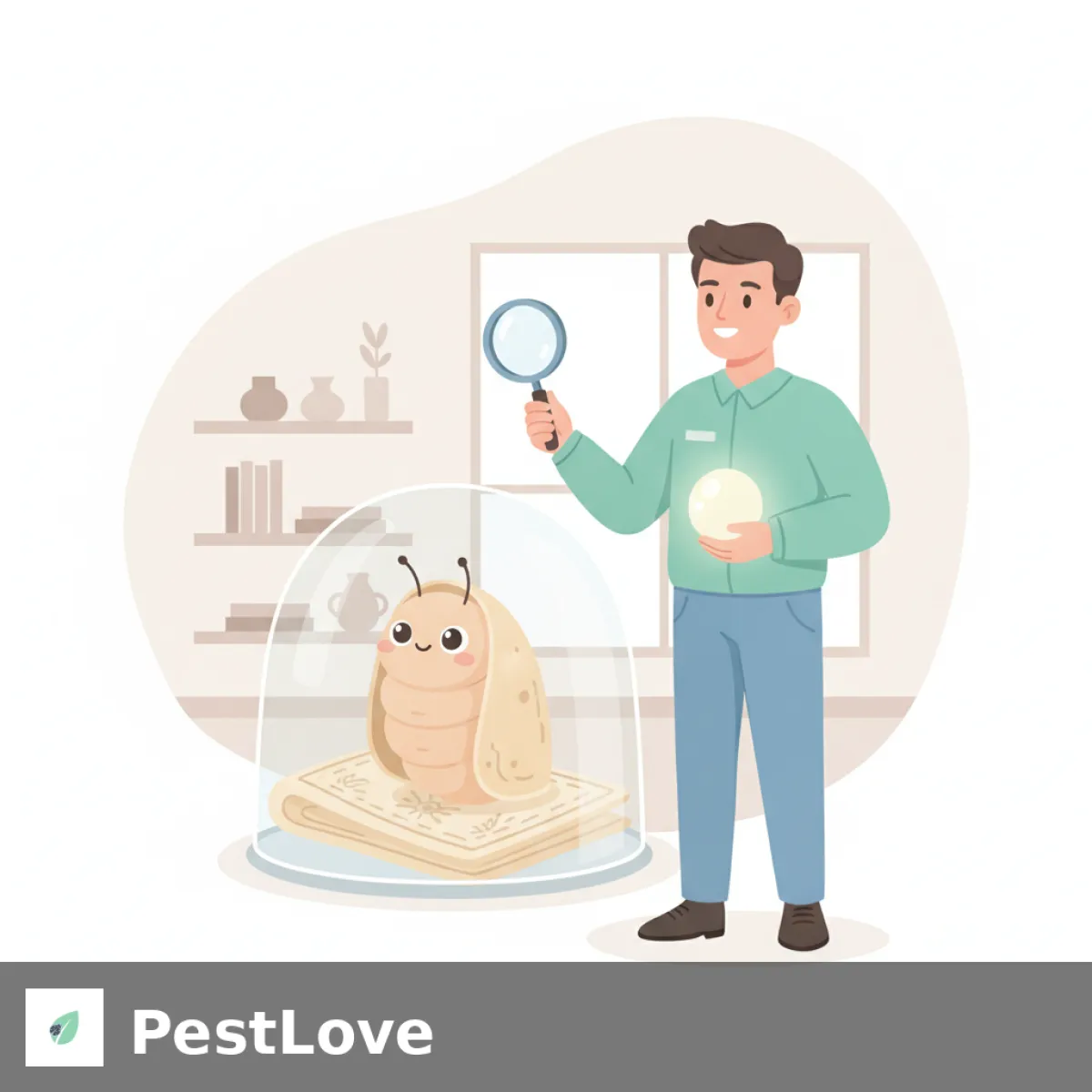
The defining characteristic of this species is the cigar-shaped silken case. The larva constructs this protective shell from spun silk and fibers from the textile it is consuming. This allows the larva to blend perfectly with the artifact, making visual detection during early infestation stages difficult. As the larva grows, it enlarges the case from both ends. When threatened, it retreats entirely inside.
Life Cycle and Environmental Needs
Understanding the pest's biology reveals its weaknesses:
- Diet: Exclusive consumers of keratin (animal protein). They target soiled areas first, where sweat or food residue provides essential Vitamin B.
- Humidity: T. pellionella is more dependent on moisture than other fabric pests. They thrive in environments with relative humidity (RH) above 75%. In drier conditions, many larvae die before pupation.
- Pupation: Uniquely, the larva often migrates away from the food source to pupate, climbing walls or hiding in crevices. This behavior complicates treatment, as the source of the infestation (the rug) and the pupation site (the baseboard) may be separated.
Damage Assessment in Collections
Damage from Case-Bearing Clothes Moths manifests as "grazing"—irregular surface removal of fibers—rather than the deep, tunneling holes often associated with other species. However, on thin textiles like antique silk, grazing can result in complete structural failure.
Inspectors should look for:
- Clean holes: Unlike the messy webbing of T. bisselliella, the feeding areas are often cleaner.
- Frass: Minute, sand-like fecal pellets often dyed the color of the consumed fabric.
- Attached Cases: Pupal cases cemented to the fabric or nearby surfaces (undersides of shelves, display case corners).
For comparative analysis with other wool-destroying moths, consult our resource on Protecting Heritage Textiles: Webbing Clothes Moth Prevention.
Remediation Protocols for Heritage Artifacts
When an infestation is confirmed within a collection, immediate action is required to halt damage and prevent spread. Chemical sprays are rarely appropriate for direct application to artifacts. Instead, physical remediation methods are the industry standard.
1. Isolation and Bagging
The infested object must be immediately isolated. Wrap the item in acid-free tissue (if fragile) and seal it within heavy-duty polyethylene bags. Tape all seams completely. This prevents escaping adults from colonizing other areas of the storage facility.
2. Low-Temperature Treatment (Freezing)
Freezing is the most common and cost-effective method for killing all life stages, including eggs. However, rapid temperature changes can damage composite materials (e.g., painted silk, wax figures). Consult a conservator before freezing.
- Protocol: Place the bagged item in a freezer capable of reaching -30°C (-22°F).
- Duration: Maintain temperature for at least 72 hours.
- Cycling: Some protocols recommend a "freeze-thaw-freeze" cycle to shock resistant larvae, though -30°C usually suffices in a single cycle.
- Acclimatization: Allow the object to return to room temperature slowly before unsealing the bag to prevent condensation from forming on the artifact.
3. Anoxia (Oxygen Deprivation)
For items that cannot withstand freezing (e.g., brittle ancient leathers, composite objects), controlled atmosphere treatment is the preferred alternative.
- Method: The object is sealed in a barrier film with oxygen scavengers (like Ageless™) or purged with nitrogen/argon gas.
- Target: Oxygen levels must be maintained below 0.3% for 21 days to ensure mortality of eggs.
- Advantage: No chemical residues and no physical stress on the object.
4. Heat Treatment (Thermo-Lignum)
Controlled humidity heat treatment chambers can raise the core temperature of an object to 52°C (125°F) while maintaining stable humidity. This kills insects in hours rather than weeks. This is specialized work requiring expensive infrastructure, often used for treating large batches of rugs. For similar protocols regarding wool inventory, see Protecting Wool Inventory for Rug Merchants.
Prevention and Environmental Control
Post-remediation, the environment must be altered to discourage re-infestation.
Sanitation and Exclusion
Vacuum storage areas with HEPA-filter vacuums to remove microscopic wool dust and hair that serves as a food source. Seal cracks and crevices in storage rooms to eliminate pupation sites. Ensure windows are screened to prevent adults from entering from outside bird nests, a common reservoir for Tinea pellionella.
Climate Management
Maintain storage areas at cool temperatures (below 18°C/65°F) and low humidity (45-50% RH). Desiccants can be used in micro-climates (display cases) to lower humidity locally, making the environment hostile to larvae.
When to Call a Professional
While conservation staff often handle individual object remediation, professional pest managers are required for facility-wide issues. Engage a professional if:
- Pheromone Traps Show Spikes: Consistent capture of adult males in monitoring traps indicates an active breeding population in the building structure.
- Structural Infestation: Moths are found feeding on debris in air ducts, sub-floors, or insulation.
- High-Value Remediation: You require the use of large-scale nitrogen bubbles or heat chambers that are not available in-house.
