
Key Takeaways
- Blattella germanica populations in urban Turkey and Israel carry documented resistance to pyrethroids, organophosphates, and some neonicotinoids, driven by both target-site mutations (kdr) and metabolic detoxification mechanisms.
- Multi-outlet restaurant and catering groups must implement site-specific resistance profiling rather than network-wide blanket treatments to avoid accelerating resistance.
- Rotation protocols must be structured by IRAC Mode of Action (MoA) group, not merely by active ingredient or product brand.
- Gel bait rotation combined with insect growth regulators (IGRs) and non-chemical harborage elimination forms the backbone of effective IPM for food service environments.
- Centralized data management across outlets is essential for identifying resistance drift before population-wide treatment failure occurs.
- Professional pest management contractors with access to bioassay capability should be engaged for any group operating five or more outlets.
Why Resistance Is a Systemic Risk for Multi-Outlet Operators
For restaurant chains, hotel catering operations, and contract catering groups managing multiple sites in Turkey and Israel, a single instance of treatment failure can cascade rapidly. Unlike a standalone restaurant that can escalate to a new product when one fails, multi-outlet groups risk deploying the same ineffective chemistry across dozens of kitchens simultaneously — accelerating resistance selection pressure across the entire network.
Research published by Turkish and Israeli academic institutions confirms that urban Blattella germanica populations in cities including Istanbul, Ankara, Izmir, Tel Aviv, and Jerusalem carry measurable resistance ratios to deltamethrin, cypermethrin, and chlorpyrifos, with some strains exhibiting resistance ratios exceeding 200-fold compared to susceptible reference strains. This level of resistance renders standard surface spray applications practically inert in field conditions. For operators, this is not merely a pest management inconvenience — it is a food safety compliance liability under both Turkish Ministry of Agriculture and Forestry (TÜRKVET) standards and Israel's Ministry of Health Pest Control Regulations.
For a broader operational framework applicable to commercial kitchens dealing with resistant populations, the guide on Managing German Cockroach Resistance in Commercial Kitchens provides complementary context.
Understanding Resistance Mechanisms in Blattella germanica
Effective rotation protocols must be grounded in an understanding of the biological mechanisms underpinning resistance. Three primary mechanisms are documented in field populations across the Eastern Mediterranean:
- Target-site insensitivity (kdr and super-kdr mutations): Mutations in the voltage-gated sodium channel gene render pyrethroid molecules unable to bind effectively, producing high-level resistance to all Type I and Type II pyrethroids.
- Metabolic resistance via cytochrome P450 monooxygenases: Elevated P450 enzyme activity detoxifies a range of insecticide classes, including pyrethroids, organophosphates, and some neonicotinoids. This cross-resistance mechanism is of particular concern because it can confer simultaneous resistance to structurally unrelated compounds.
- Esterase-mediated hydrolysis: Elevated carboxylesterase activity has been documented in Turkish urban strains and contributes to organophosphate resistance.
Understanding which mechanisms are active at a specific site determines which MoA classes remain viable — making resistance testing a prerequisite for intelligent rotation, not an optional enhancement.
Resistance Testing Protocols for Field Conditions
Multi-outlet operators should mandate the following testing approaches through their contracted pest management provider, ideally on a semi-annual basis or whenever treatment efficacy is suspected to have declined:
1. Discriminating Dose Bioassay
The discriminating dose bioassay, based on World Health Organization methodology, exposes a representative sample of collected cockroaches to a fixed diagnostic concentration of each target insecticide. Mortality rates below 90% at the discriminating dose are interpreted as evidence of resistance. Samples should be collected using sticky monitors from high-harborage zones — beneath cooking equipment, inside false floor voids, and around drain channels. A minimum of 20 live adults per outlet provides statistically meaningful results.
2. PCR-Based kdr Genotyping
Where laboratory access permits, PCR screening of the para-type sodium channel gene identifies kdr and super-kdr allele frequencies in collected specimens. Israeli universities and Turkish agricultural research institutions offer this service through their applied entomology departments, and several commercial pest management providers in both countries have established access to this diagnostic capability. PCR genotyping is particularly valuable for detecting resistance before phenotypic failure becomes apparent in field treatments.
3. Topical Application Assay
For groups operating their own in-house pest management teams, the topical application method — applying a measured dose of technical-grade active ingredient directly to individual anaesthetised cockroaches — allows dose-response curves to be constructed. Resistance ratios above 10-fold relative to a susceptible reference strain indicate resistance that will likely compromise field performance.
Testing data should be recorded outlet by outlet and compiled into a central resistance database. This longitudinal record allows trend analysis — identifying which outlets are showing resistance drift before complete treatment failure occurs. Operators preparing for GFSI or BRC Food Safety audits will find this documentation directly relevant; see the guide on Preparing for GFSI Pest Control Audits for documentation frameworks.
Insecticide Rotation Frameworks by IRAC Mode of Action
Rotation must occur between IRAC MoA groups, not merely between brands or formulations within the same group. The following MoA classes are currently viable for gel bait and surface application rotation in food service environments across Turkey and Israel, subject to local registration status:
- IRAC Group 4A — Neonicotinoids (e.g., imidacloprid, acetamiprid): Currently effective against most pyrethroid-resistant strains where metabolic cross-resistance to this class has not yet been confirmed at the target site. Used primarily in gel bait formulations.
- IRAC Group 22A — Oxadiazines (e.g., indoxacarb): Acts as a pro-insecticide, activated metabolically by the insect itself. Of significant value in resistant populations because metabolic activation separates its mechanism from standard detoxification pathways in many strains.
- IRAC Group 2B — Phenylpyrazoles (e.g., fipronil): GABA-gated chloride channel blocker; distinct from pyrethroid and organophosphate MoA classes. Registered for cockroach gel bait use in Israel and Turkey; highly effective in pyrethroid-resistant populations.
- IRAC Group 13 — Pyrroles (e.g., chlorfenapyr): Uncouples oxidative phosphorylation; distinct mechanism useful in rotation schedules. Registration status should be verified with the relevant national authority before use.
- Insect Growth Regulators — IRAC Groups 7 and 15 (e.g., (S)-methoprene, hydroprene, novaluron): IGRs do not kill directly but disrupt moulting and reproduction, collapsing population growth over time. Incorporating IGRs into rotation schedules reduces selection pressure on adulticides by targeting different life stages.
- Inorganic and non-IRAC classified materials (e.g., boric acid, diatomaceous earth): Non-target-site mechanisms; resistance development is extremely slow. Boric acid dust applied to harbourages and void spaces provides a complementary, resistance-proof layer in any IPM programme.
Recommended Rotation Schedule for Multi-Outlet Groups
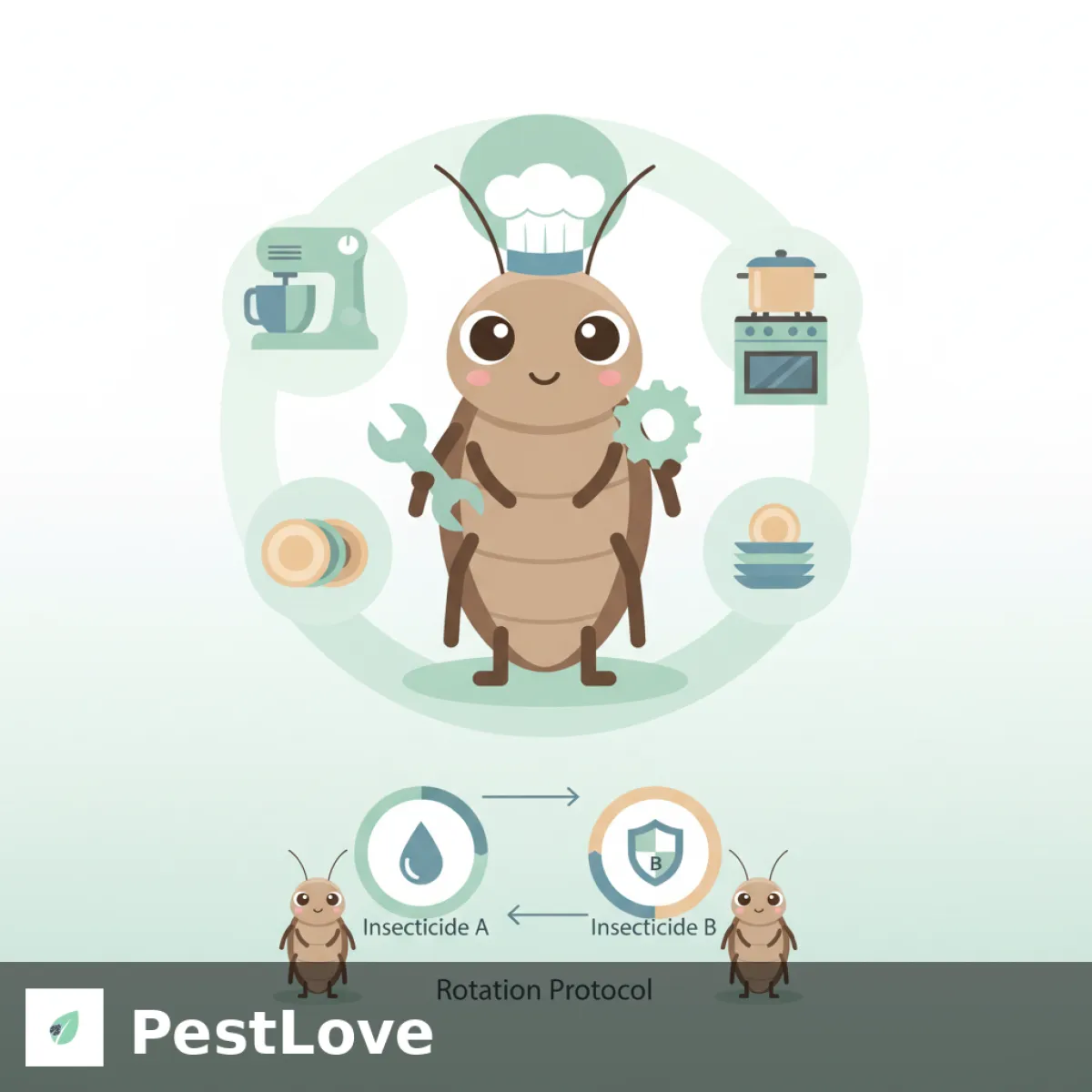
A practical rotation cadence for restaurant groups in both countries should proceed as follows: Cycle 1 — fipronil-based gel bait as primary adulticide, supplemented with boric acid dust in inaccessible voids and an IGR applied to harbourage zones. Cycle 2 (following a minimum 8–12 week interval) — indoxacarb-based gel bait replacing fipronil entirely, with continued IGR and boric acid. Cycle 3 — neonicotinoid-based gel bait if resistance testing confirms susceptibility. Return to Cycle 1 only after a full rotation through all available MoA classes.
Critically, gel baits should never be mixed with surface spray residuals at the same application. Residual sprays applied near bait stations trigger bait aversion in cockroach populations and sharply reduce ingestion rates, undermining the programme's primary vector of control.
Multi-Outlet Operational Protocols
For groups managing five or more outlets across Turkish or Israeli cities, the following structural protocols are recommended:
- Centralised Resistance Mapping: Maintain a network-level database recording bioassay results, product history, and population counts by outlet. Review quarterly at minimum.
- Outlet Clustering by Resistance Profile: Do not apply the same rotation cycle uniformly across all outlets. Group sites by their confirmed resistance profiles and assign MoA cycles accordingly. An outlet in Şişli (Istanbul) may carry different resistance allele frequencies than one in Kadıköy.
- Supplier Coordination: Ensure the contracted pest management provider submits written service reports specifying the active ingredient, IRAC group, formulation type, and application zone for every visit. Verbal reporting is insufficient for audit purposes or resistance trend analysis.
- Staff Training: Kitchen management staff should be trained to identify early infestation signs — particularly oothecae (egg cases), cast skins, and frass deposits beneath equipment — and report them immediately rather than waiting for scheduled service visits. Early detection prevents population buildup that accelerates resistance selection.
- Sanitation Integration: Insecticide rotation is not a standalone solution. Sanitation protocols addressing grease accumulation, drain biofilm, and structural harbourage must run concurrently. For drain management in kitchen environments, the guide on Drain Fly Eradication for Restaurants outlines complementary sanitation approaches applicable to cockroach harborage zones.
For catering operations managing large-volume buffet events — a common scenario in both Turkish and Israeli hospitality catering — the particular challenges of temporary high-volume food service are addressed in the guide on Food Safety and Pest Management for Ramadan Tents and Large-Scale Buffets.
Regulatory Context: Turkey and Israel
In Turkey, pest control operations in food premises are regulated under the Veterinary Services, Plant Health, Food and Feed Law (Law No. 5996) and enforced by the Ministry of Agriculture and Forestry. Pest control service providers must hold a biocide application licence, and the products used must be registered with the TÜRKVET biocide database. Multi-outlet operators should verify that contracted providers hold current licences and that all applied products carry valid Turkish registration for use in food handling areas.
In Israel, the Ministry of Health oversees pest control through the Pest Control Law (1994) and associated regulations. Licensed pest controllers (Class A licence for complex operations) are required for commercial food premises. The Ministry's list of approved biocides is updated periodically, and operators should confirm product registration status before committing to a rotation schedule — particularly for newer formulations not yet present in the local market.
When to Call a Professional
Multi-outlet restaurant and catering operators should engage a qualified, licensed pest management professional — rather than relying on in-house maintenance staff — in all of the following circumstances:
- When gel bait consumption has ceased despite confirmed cockroach activity, indicating bait aversion or population collapse at the current MoA class.
- When cockroach populations are observed during daytime hours, which typically indicates severely overcrowded harborages and a mature infestation requiring urgent intervention.
- When resistance bioassay results indicate resistance ratios above 50-fold to two or more MoA classes, necessitating a specialist reformulation of the rotation programme.
- Prior to any food safety audit, regulatory inspection, or franchise brand audit where pest evidence would constitute a critical non-conformance.
- When structural deficiencies — such as failed grouting, open pipe penetrations, or disintegrated equipment bases — are creating harborages that cannot be addressed through chemistry alone.
For cloud kitchen and ghost kitchen operators in Turkey and Israel — a fast-growing segment with high cockroach pressure — the guide on Spring Cockroach Surge Prevention for Cloud Kitchen and Ghost Kitchen Operations addresses the sector-specific vulnerabilities that make professional oversight particularly important in these formats.
