
Key Takeaways
- Termites are 'silent destroyers' that can cause massive structural damage before being detected.
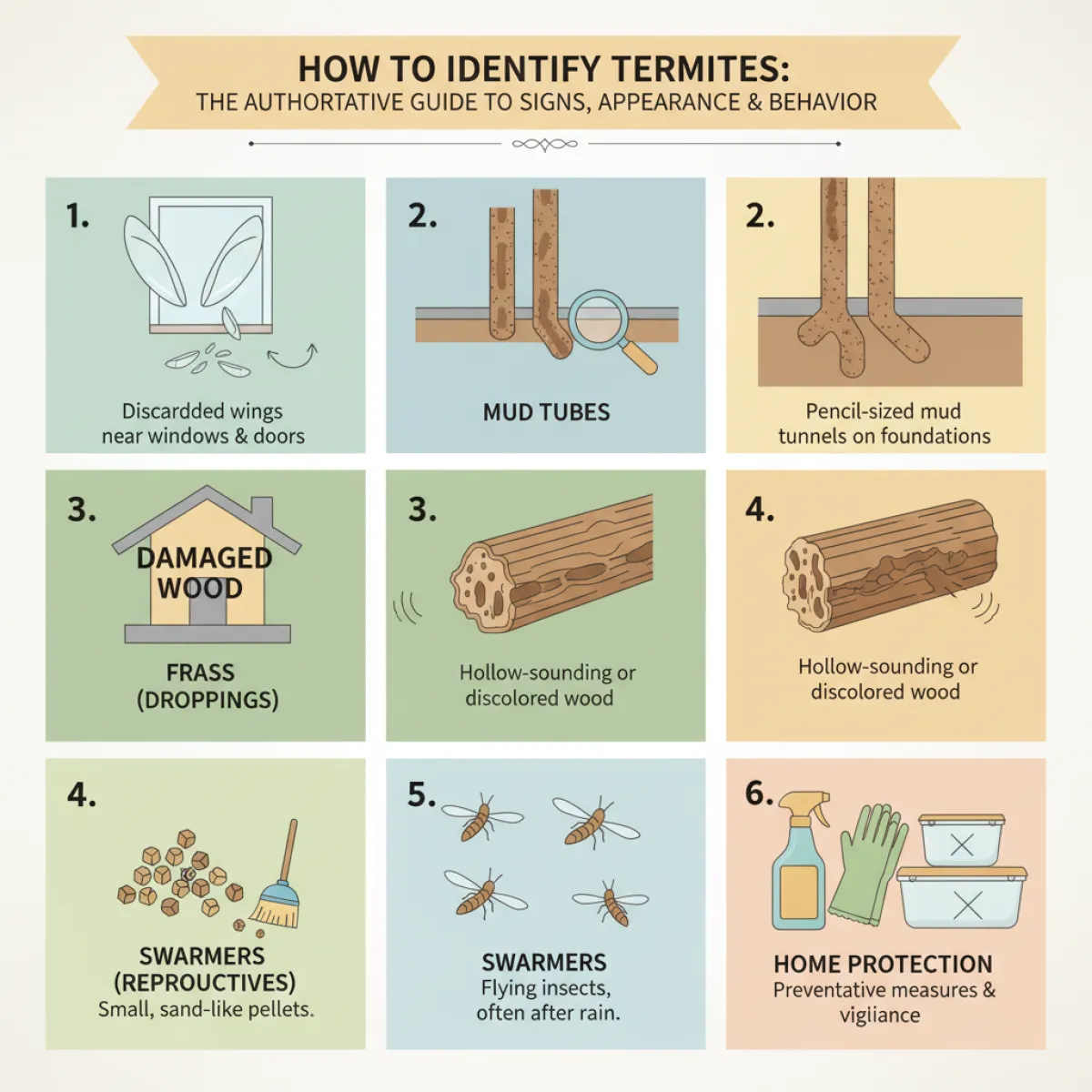
- Key signs include mud tubes, discarded wings, hollow-sounding wood, and frass (droppings).
- Distinguishing between termites and flying ants is essential for correct treatment.
- Early professional intervention saves thousands of dollars in repair costs.
In my 15 years as a certified pest control professional and entomologist, I have witnessed firsthand the devastating impact of termites on homes. Often, by the time a homeowner notices a problem, the damage is already extensive. Termites belong to the order Isoptera and are highly organized social insects. In the United States, we primarily deal with Eastern Subterranean termites (Reticulitermes flavipes), the highly aggressive Formosan termites (Coptotermes formosanus), and various Drywood species. Understanding their biology and the subtle clues they leave behind is your best defense.
Termite Appearance: Identification by Caste
Termites are not just 'white ants.' Their morphology is distinct, and within a single colony, you will find three primary castes:
1. Workers
Workers make up the bulk of the colony and are responsible for feeding the nest. They are approximately 1/4 inch long, soft-bodied, and creamy white. Because they are sensitive to light and desiccation, they remain hidden within wood or soil.
2. Soldiers
Soldiers are the colony's defenders. They have pale bodies like workers but possess large, brownish, armored heads with powerful mandibles. They use these to fend off predators, primarily ants.
3. Swarmers (Alates)
Swarmers are the reproductive members of the colony. They are dark brown to black and possess two pairs of translucent wings. A termite swarm inside a home is a definitive sign of a mature infestation nearby.
Termites vs. Flying Ants: Know the Difference
One of the most frequent calls I receive involves mistaking flying ants for termites. Using Integrated Pest Management (IPM) diagnostic principles, look for these three characteristics:
- The Waist: Termites have a broad waist, while ants have a distinct, pinched 'wasp-like' waist.
- The Antennae: Termite antennae are straight and beaded. Ant antennae are elbowed or bent.
- The Wings: Termites have four wings of equal length. Ants have larger front wings and smaller hind wings. Termite wings also shed easily, leaving behind piles of 'silver' scales on windowsills.
Critical Signs of a Termite Infestation
Because termites live inside their food source, detection requires looking for indirect evidence of their presence.
Mud Tubes
Subterranean termites require moisture to survive. They build pencil-thin mud tubes made of soil, saliva, and fecal matter to travel from the ground to the wood of your home. These are commonly found on foundation walls, joists, and in crawl spaces.
Hollow-Sounding Wood
Termites consume cellulose from the inside out, often leaving a thin veneer of wood or paint intact. If you tap on a timber or wall and it produces a dull, hollow thud, it may be infested. In severe cases, you might even be able to poke a finger through the drywall.
Discarded Wings
After a reproductive swarm, termites shed their wings. Finding piles of small, uniform wings near windows, doors, or light fixtures is a classic indicator that a colony is attempting to establish itself in your structure.
Termite Frass
Drywood termites do not build mud tubes. Instead, they kick their excrement out of small 'kick-out holes.' This frass looks like tiny, hexagonal pellets or coarse sand and often accumulates in small mounds beneath infested wood.
Termite Behavior and Professional Insights
Termites are active 24/7, 365 days a year. They communicate through pheromones and head-banging. If you listen closely to an infested wall, you may hear a faint clicking sound; this is the soldiers signaling an alarm. Formosan termites, often called 'super termites,' can consume wood at an alarming rate and even build aerial nests (cartons) if they have a consistent water source, such as a leaky roof.
When to Call a Professional
Termite control is not a DIY project. The EPA and major university extension services recommend professional treatment for several reasons:
- Specialized Equipment: Professionals use infrared cameras, moisture meters, and acoustic sensors to locate hidden nests.
- Effective Barriers: Liquid termiticides must be applied precisely to create a continuous chemical barrier.
- Baiting Systems: Advanced systems like Sentricon require professional monitoring to ensure colony elimination.
- Safety: Handling concentrated termiticides requires specific training and protective gear.
If you see any of the signs mentioned above, contact a certified professional immediately for a comprehensive inspection.
Conclusion
Protecting your home from termites requires a combination of vigilance and professional expertise. By reducing moisture around your foundation, keeping firewood away from the house, and knowing how to identify the early warning signs, you can prevent significant financial loss. Remember, an ounce of prevention is worth a pound of cure—especially when dealing with the silent destroyers of the insect world.
