Key Takeaways
- Rainy season pest pressure peaks across Nigeria from April through October, with Lagos, Port Harcourt, and the Niger Delta facing the earliest onset and highest humidity loads.
- A four-to-six week pre-season audit calendar allows food manufacturers to remediate exclusion gaps, drainage faults, and sanitation weaknesses before flying termites (Macrotermes bellicosus), Norway rats (Rattus norvegicus), and stored-product moths intensify.
- NAFDAC, GFSI (FSSC 22000, BRCGS, SQF), and HACCP frameworks require documented pest control programs with trend analysis, corrective actions, and licensed applicator records.
- Rooftop drainage, raw material intake, and external perimeters are the three highest-risk audit zones during the pre-rainy season window.
- Licensed pest management professionals should conduct the structural and chemical components of the audit; in-house teams handle daily monitoring and sanitation verification.
Why a Structured Pre-Rainy Season Audit Matters
Nigeria's rainy season transforms pest pressure inside food manufacturing facilities. Rising humidity accelerates the breeding cycles of German cockroaches (Blattella germanica) and tropical warehouse moths, while saturated soils drive subterranean termite alates and rodents toward elevated, dry harborage — typically the warm, food-rich environment of a processing plant. According to Integrated Pest Management (IPM) frameworks endorsed by the U.S. Environmental Protection Agency and university extension services, the most cost-effective interventions occur before the population surge, not after contamination is detected.
For manufacturers operating under NAFDAC oversight or GFSI-recognized schemes such as FSSC 22000 and BRCGS, an undocumented or reactive program is a leading cause of audit non-conformities. A defined calendar — anchored to the meteorological onset of the rains — produces the records, trend data, and corrective action history that auditors expect.
Identification: Priority Pests for Nigerian Food Manufacturers
Flying Termites (Macrotermes and Microcerotermes spp.)
Alate swarms emerge with the first heavy rains. Indicators include shed wings near light fixtures, mud tubes on external walls, and hollow-sounding pallet timber. Subterranean species can compromise wooden dunnage, fibreboard packaging, and structural timber within weeks.
Rodents
Norway rats and roof rats (Rattus rattus) seek dry shelter as flooding displaces burrows. Signs include sebum rub marks along wall-floor junctions, gnawing damage on conduit and bagged commodities, and droppings near pallet bases.
Stored-Product Insects
The tropical warehouse moth (Ephestia cautella), Indian meal moth (Plodia interpunctella), and rice weevil (Sitophilus oryzae) thrive in elevated humidity. Webbing in raw material sacks, frass in seams, and adult flight near pheromone traps are early indicators.
Cockroaches and Filth Flies
German cockroaches dominate processing zones; American cockroaches (Periplaneta americana) and oriental cockroaches exploit drains and sumps. Filth fly populations, including Musca domestica, surge as standing water accumulates around perimeters.
Behavior: How the Rains Reshape Pest Pressure
Three behavioral shifts drive the pre-season risk profile. First, swarming: termite reproductives time their dispersal flights to atmospheric moisture and barometric drops, meaning the first heavy rain can deposit thousands of alates against perimeter lighting overnight. Second, flood displacement: rodents, cockroaches, and ants abandon waterlogged outdoor harborage and follow utility penetrations indoors. Third, commodity moisture uptake: hygroscopic raw materials such as flour, cassava starch, milk powder, and cocoa absorb ambient humidity, accelerating stored-product insect development from a typical 35-day cycle to under 28 days at sustained 75% relative humidity.
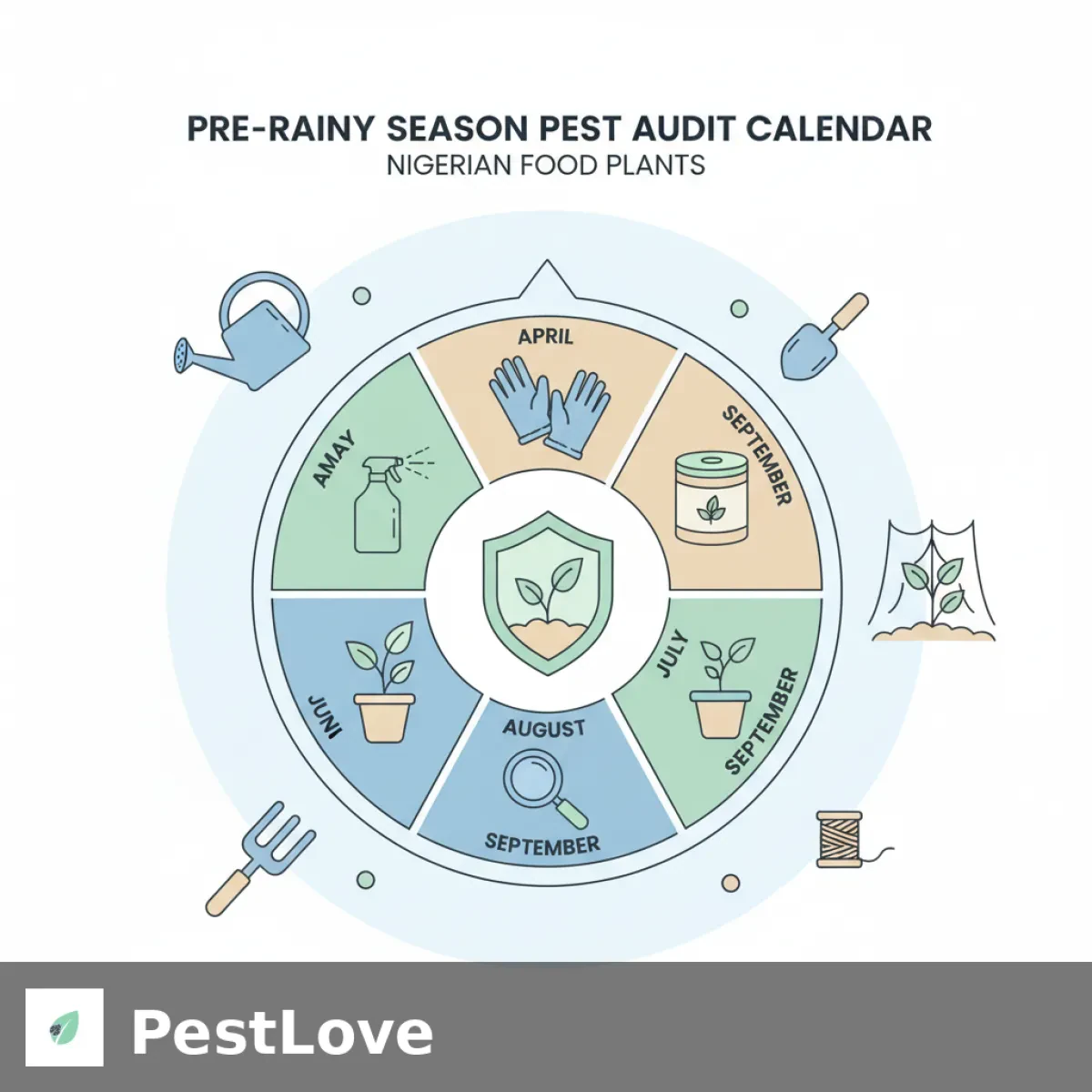
The Pre-Rainy Season Audit Calendar
Week 1 (Six Weeks Before Onset): Documentation and Trend Review
- Pull twelve months of trap counts, sighting logs, and corrective action reports.
- Map activity hotspots against floor plans; identify recurring zones.
- Verify NAFDAC-registered product lists and licensed applicator credentials are current.
- Confirm Material Safety Data Sheets and pesticide usage logs are accessible for audit.
Week 2: External Perimeter and Grounds Audit
- Inspect a 10-metre perimeter band for vegetation, debris, and standing water.
- Assess drainage gradients, blocked culverts, and roof downpipe discharge points.
- Review external lighting: replace mercury vapour with sodium or LED amber to reduce termite alate attraction.
- Inspect waste compaction and skip locations; confirm minimum 15-metre offset from intake doors where layout permits.
Week 3: Building Envelope and Exclusion
- Verify door sweeps maintain less than 6mm clearance; rodents exploit gaps as small as 12mm.
- Seal utility penetrations with rodent-proof materials (stainless mesh, copper wool, cementitious mortar).
- Inspect roof flashing, ventilation louvres, and ceiling voids for daylight gaps.
- Audit insect light trap placement, lamp age (replace annually), and glueboard rotation schedules.
Week 4: Internal Sanitation and Structural Inspection
- Conduct deep sanitation of equipment voids, conveyor undersides, and electrical panels.
- Probe wooden pallets, dunnage, and structural timber for termite galleries.
- Verify First-Expired-First-Out rotation in raw material warehouses.
- Calibrate and reposition pheromone monitors for stored-product moths and beetles.
Week 5: Treatment and Pre-Season Interventions
- Engage a licensed pest management professional for soil termiticide treatment around foundation perimeters where appropriate.
- Apply residual insecticide bands to external walls and crack-and-crevice formulations indoors per label and NAFDAC guidance.
- Pre-bait rodent stations along established runways; use tamper-resistant stations only.
Week 6: Verification, Training, and Documentation
- Conduct internal mock audit using GFSI checklists.
- Train production, warehouse, and sanitation staff on pest sighting reporting.
- Finalize the rainy season escalation matrix and contractor service-level agreement.
Prevention: Building a Resilient IPM Program
Prevention rests on the four IPM pillars: exclusion, sanitation, monitoring, and targeted treatment. Exclusion failures account for the majority of rainy-season ingress events; a single unsealed cable penetration can admit hundreds of cockroaches over a wet weekend. Sanitation programs must address moisture as aggressively as food residue — wet mopping without thorough drying creates fly and cockroach harborage. Monitoring relies on calibrated devices placed on a defined grid, with weekly counts trended against environmental conditions. Treatment, when required, should follow a rotation strategy to avoid resistance, particularly with pyrethroid-dependent cockroach programs.
Manufacturers can cross-reference broader frameworks in the GFSI pest control audit checklist and the rainy-season compliance guide for Nigerian food plants. For warehouse-specific stored-product strategies, see the Kenyan grain warehouse moth prevention guide.
Treatment: Professional-Grade Interventions
Chemical interventions during the audit window should follow label directions, NAFDAC registration status, and the principle of minimum effective dose. Soil-applied non-repellent termiticides containing fipronil or imidacloprid create transfer effects within termite colonies. Insect growth regulators such as pyriproxyfen and (S)-hydroprene disrupt cockroach and stored-product moth development without immediate adult mortality, supporting longer-term population suppression. Anticoagulant rodenticides remain effective when deployed in tamper-resistant stations with documented bait acceptance.
Non-chemical interventions — including controlled atmosphere fumigation for sealed silos, pheromone-based mating disruption for pantry moths, and heat treatment of pallet stocks — reduce chemical load and align with international export expectations.
When to Call a Professional
Several scenarios warrant immediate engagement of a licensed pest management professional rather than in-house response: confirmed termite alates inside the facility envelope, rodent activity inside production zones, stored-product insect counts exceeding internal action thresholds for two consecutive weeks, structural timber damage of unknown extent, or any cockroach population suspected of insecticide resistance. NAFDAC and GFSI auditors expect documented evidence that licensed professionals conduct chemical applications and structural assessments. Serious infestations affecting product safety or structural integrity should never be addressed solely by in-house staff.
A documented pre-rainy season audit calendar, executed with a qualified contractor and verified by trained internal teams, is the most reliable safeguard against contamination, recalls, and audit non-conformities during Nigeria's most demanding pest pressure window.