
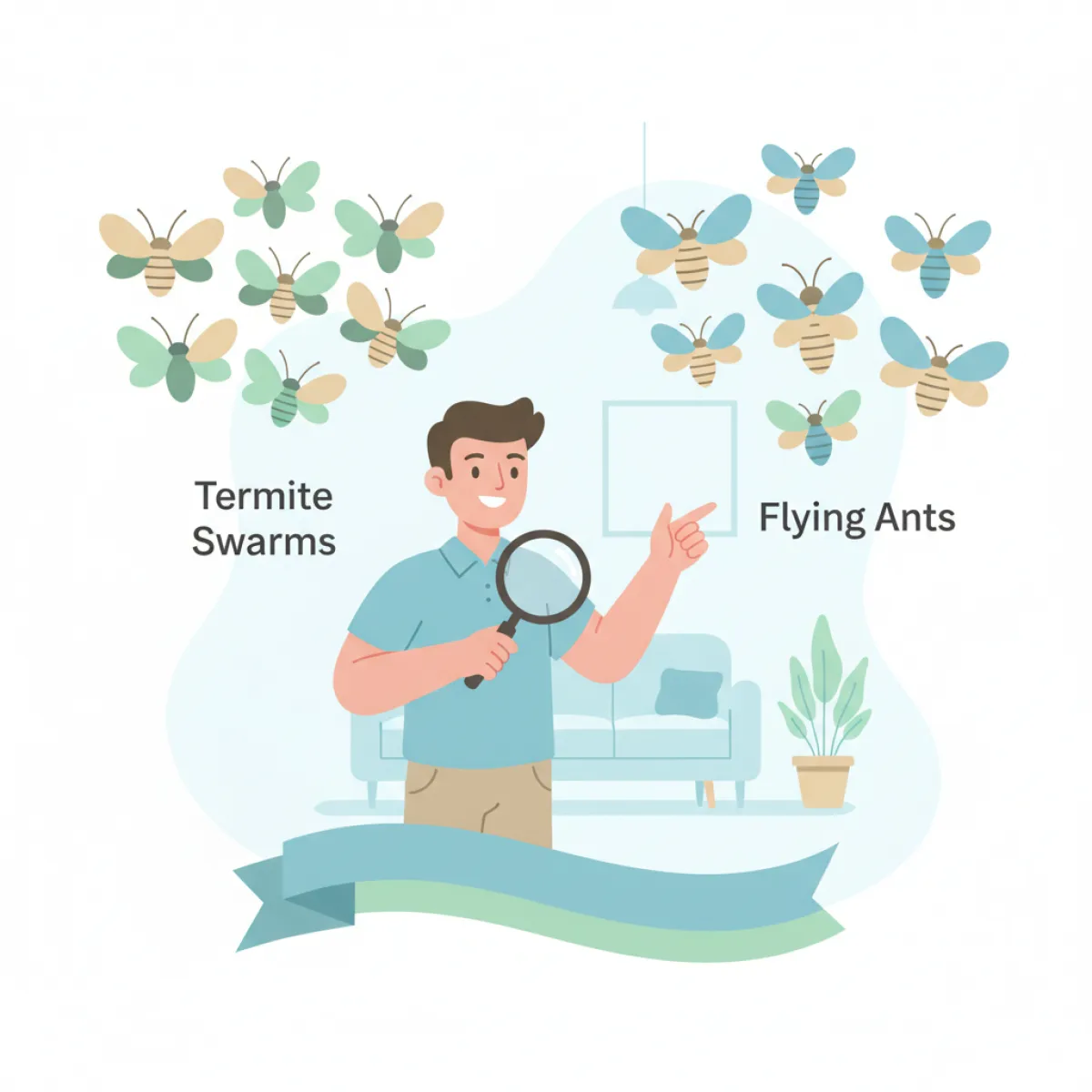
The Spring Phenomenon: Why Identification Matters
As the soil warms and early spring rains saturate the ground, a biological alarm clock triggers one of nature's most misunderstood events: the nuptial flight. For homeowners and property managers, the sudden appearance of hundreds of winged insects—often emerging from baseboards, windowsills, or foundation cracks—can be a source of immediate anxiety. In the field, I have seen many individuals mistake a destructive termite swarm for a harmless ant flight, or conversely, ignore a termite infestation thinking it was merely 'some flying ants.'
Correct identification is not just an academic exercise; it is a financial necessity. Subterranean termites, specifically species like Reticulitermes flavipes, cause billions of dollars in structural damage annually. Conversely, while some ants like the Carpenter ant (Camponotus) can damage wood, many other 'flying ants' are simply nuisance pests. Understanding the early warning signs of termite swarms is the first step in an Integrated Pest Management (IPM) strategy.
Key Takeaways for Early Spring Identification
- Antennae: Termites have straight, bead-like antennae; ants have 'elbowed' or bent antennae.
- Waist: Termites have a broad, thick waist; ants have a distinct, pinched 'wasp-waist.'
- Wings: Termite wings are equal in length and shed easily; ant wings are unequal (front wings longer than back) and remain attached longer.
- Timing: Termite swarms typically occur on warm, sunny mornings following a rain event in early spring.
The Anatomy of a Swarmer: A Professional Breakdown
When I am called to a site to identify a swarm, I always carry a 10x magnification hand lens. Without magnification, it is easy to be fooled by the fast-moving insects. Here is how we distinguish the two in a professional capacity:
1. Antennae Structure
Ants belong to the family Formicidae, and one of their defining characteristics is the geniculate (elbowed) antenna. If you look closely at a flying ant, the antenna has a clear joint. Termites, belonging to the infraorder Isoptera, possess moniliform antennae that look like a string of tiny beads and are almost always straight.
2. The Waist (Petiole)
In the pest control industry, we refer to the ant's waist as the petiole. It is a thin, constricted segment that separates the thorax from the abdomen. Termites do not have this constriction. Their body is roughly the same width from the head to the end of the abdomen, giving them a more 'cigar-shaped' appearance. If the insect looks like it has been 'pinched' in the middle, you are likely looking at an ant.
3. Wing Morphology and Shedding
The term 'Isoptera' literally means 'equal wings.' A termite swarmer (alates) has four wings that are identical in shape, size, and vein pattern. These wings are typically smoky or translucent and are twice as long as the insect's body. Ants also have four wings, but the forewings are significantly larger and longer than the hindwings. Furthermore, termites are notoriously poor flyers; they flutter clumsily and shed their wings almost immediately after landing. If you find piles of discarded, identical wings on a windowsill, it is a definitive sign of termites.
Behavioral Differences and Spring Patterns
Biology dictates behavior. Termite swarms are a reproductive strategy designed to start new colonies. In my experience, these swarms are brief, often lasting less than an hour. They are highly dependent on environmental cues—specifically a temperature of around 70°F (21°C) and high humidity following a rainstorm. If the swarm is happening inside your building, it is a near-certain indicator that a colony is already established within the structure or immediately beneath the foundation.
Ants, on the other hand, are more varied in their swarming habits. While some species swarm in spring, many others wait until the heat of mid-summer. Ant swarmers are also more robust flyers and may be seen foraging for food even after they have taken flight, whereas termite swarmers have one goal: to find a mate, shed their wings, and crawl into a moist piece of wood or soil.
The Business and Commercial Perspective
For facility managers and business owners, a swarm is more than a maintenance issue; it is a threat to business continuity and brand reputation. In hospitality or food service environments, a swarm of insects in a public area can lead to immediate negative reviews and health department scrutiny. From a structural standpoint, termites are 'silent destroyers.' By the time you see a swarm, the colony may have been feeding on your subflooring or load-bearing beams for three to five years. Protecting your commercial assets requires a proactive approach to termite prevention and regular professional inspections.
Mitigation and Professional Solutions
If you have identified the insects as termites, do not panic, but do act with urgency. DIY sprays may kill the insects you see, but they will do nothing to stop the thousands of workers still hidden in the walls. Professional mitigation involves several steps:
- Soil Barriers: Applying a non-repellent liquid termiticide around the perimeter of the structure.
- Baiting Systems: Utilizing stations that termites feed on and carry back to the colony, effectively eliminating the queen.
- Moisture Management: Addressing leaky pipes and poor drainage, as subterranean termites require constant moisture to survive.
If the insects are ants, the approach changes. You must determine if they are simply nuisance ants or if they are carpenter ants nesting in your foundation. Carpenter ants do not eat wood but excavate it to create galleries, which can still lead to structural weakness over time.
When to Call a Professional
You should contact a certified pest control professional immediately if you observe any of the following:
- A swarm occurring indoors.
- Piles of discarded wings near light sources or windows.
- Mud tubes (pencil-sized tunnels of earth) on foundation walls or floor joists.
- Hollow-sounding wood or bubbling paint that resembles water damage.
Professional entomologists use advanced tools, such as thermal imaging and acoustic sensors, to detect activity that is invisible to the naked eye. In my years of practice, I have found that a 'free inspection' is often the most valuable service a homeowner can utilize to prevent five-figure repair bills later.
Conclusion
Distinguishing between termite swarmers and flying ants in early spring is a fundamental part of property stewardship. By focusing on the three main anatomical markers—antennae, waist, and wings—you can make an informed decision on how to proceed. While ants can be a nuisance, termites are a structural emergency. Always prioritize safety and professional verification to ensure your home or business remains a pest-free environment.
