
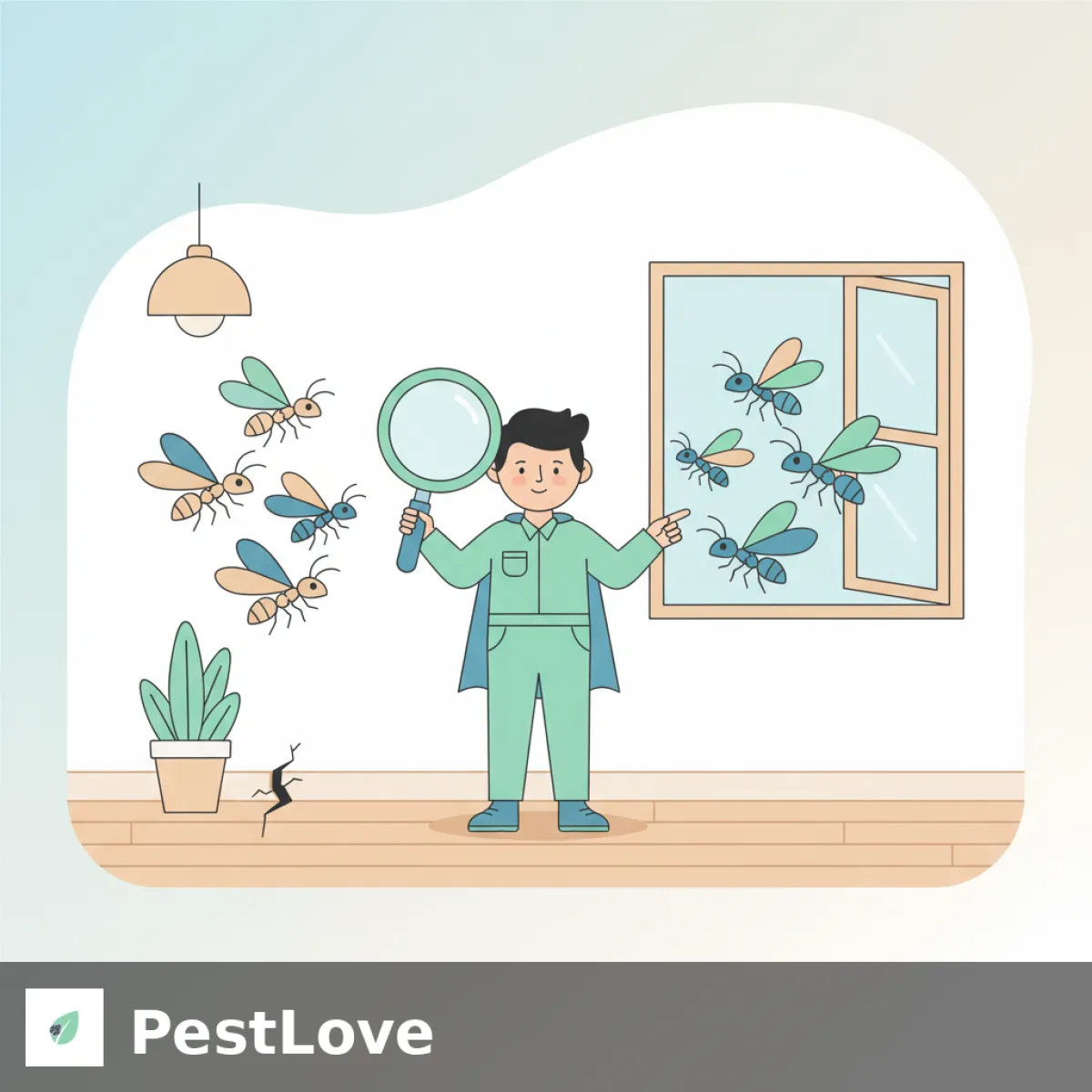
The Spring Awakening: Friend or Foe?
As the ground thaws and early spring rains saturate the soil, a phenomenon occurs that strikes fear into the heart of every informed homeowner: the sudden appearance of winged insects inside the home. I have stood in countless living rooms where a frantic homeowner points to a window sill covered in what looks like shimmering confetti. "Are these termites?" they ask, panic evident in their voice.
In the pest control industry, we call this "Swarm Season." It is the time when reproductive members of ant and termite colonies—called alates—take flight to mate and establish new colonies. While the sight is alarming, immediate identification is the key to measuring the threat. Mistaking a carpenter ant for a termite might cost you sleep, but mistaking a Subterranean termite for an ant could cost you your home's structural integrity.
This guide provides the immediate, professional-grade visual benchmarks we use in the field to distinguish between Reticulitermes flavipes (Eastern Subterranean Termite) swarmers and the alates of common ant species like Camponotus (Carpenter Ants).
The "3-Point Check": Immediate Visual Identification
You do not need a degree in entomology to tell the difference, but you do need a magnifying glass or a good phone camera. When examining a specimen, focus on three distinct body parts: the antennae, the waist, and the wings.
1. The Antennae (Feelers)
- Termites: Possess straight, beaded antennae. They look like a string of tiny pearls. There is no bend.
- Flying Ants: Have elbowed antennae. They have a distinct 90-degree bend or "elbow" in the middle.
2. The Waist (Abdomen Connection)
- Termites: Have a broad waist. Their body looks essentially like a single, uniform cylinder. There is no clear separation between the thorax (middle) and the abdomen (rear).
- Flying Ants: Have a pinched, wasp-like waist. The constriction between the thorax and abdomen is very narrow and distinct.
3. The Wings (Shape and Size)
This is often the easiest trait to spot, especially if you find discarded wings.
- Termites: Have four wings that are equal in length. Both the front and hind wings are the same size and possess a milky, translucent quality with many visible veins. Crucially, termites are poor flyers and tend to shed their wings almost immediately after landing.
- Flying Ants: Have four wings of unequal length. The front wings are significantly longer than the hind pair. Their wings are often clearer and less veined than those of a termite.
For a deeper dive into termite specific traits, review our guide on termite signs, appearance, and behavior.
Behavioral Differences: Clues Beyond Appearance
Beyond physical anatomy, the behavior of the swarm tells a story.
The "Discarded Wing" Phenomenon
If you find a pile of wings on a window sill or near a door but no insects, you are likely dealing with termites. Subterranean termites are biologically programmed to twist off their wings shortly after their nuptial flight. Ants, conversely, often keep their wings attached for longer periods as they search for a nesting site.
The Source of the Swarm
Observe where the insects are emerging from. Termite swarmers in a home often emerge from mud tubes in the foundation, expansion joints in the garage, or even directly from baseboards. This indicates an established colony under or in your home. Flying ants often congregate around high points like chimneys or roof lines, or emerge from rotting wood outdoors.
Why Identification Matters: The Risk Profile
The Termite Threat
If you confirm the insect is a termite, it is a Class-A emergency. A swarm inside a structure usually indicates that a mature colony (typically 3-5 years old) is already present. They are not "coming in" to eat your house; they are likely already eating it. Immediate professional inspection is required to map the extent of the infestation.
The Flying Ant Nuisance (and Exception)
Most flying ants are a nuisance rather than a structural threat. However, the Carpenter Ant is the exception. While they do not eat wood like termites, they excavate it to build nests. If you identify large black ants with wings, you should treat them seriously. Learn more about protecting your foundation in our guide to early spring carpenter ant prevention.
Immediate Steps to Take
- Do Not Panic, Do Not Spray: It is instinctual to grab a can of aerosol insecticide. Don't. Spraying the swarmers kills the messengers but does nothing to the colony. Worse, it contaminates the area, making it harder for a professional to identify the entry point or use non-repellent termiticides effectively.
- Collect a Sample: Place a few of the insects (dead or alive) into a ziplock bag or a jar with rubbing alcohol. This physical evidence is invaluable for your pest management professional.
- Vacuum: If the swarm is overwhelming, vacuum them up. Discard the bag immediately outside.
- Inspect the Perimeter: Look for mud tubes on your foundation or rotting wood near the house. For more on what to look for, read about spotting termite swarms in your foundation.
- Call a Professional: Termites are not a DIY project. They require specialized equipment and termiticides (like liquid barriers or bait systems) that are not available to the general public.
Conclusion
Seeing winged insects in your home is a call to action, not a cause for despair. By using the "Antennae, Waist, Wing" check, you can determine if you are facing a nuisance ant issue or a termite threat. Remember, early detection is the greatest money-saver in pest control. If you suspect termites, consult our definitive guide to termite prevention and contact a licensed professional immediately.