English
Why Spiders Appear Indoors in Autumn
Autumn spider sightings often increase when mature males roam in search of mates. Existing indoor populations, accidental entry, available prey, and building access also influence what people see.
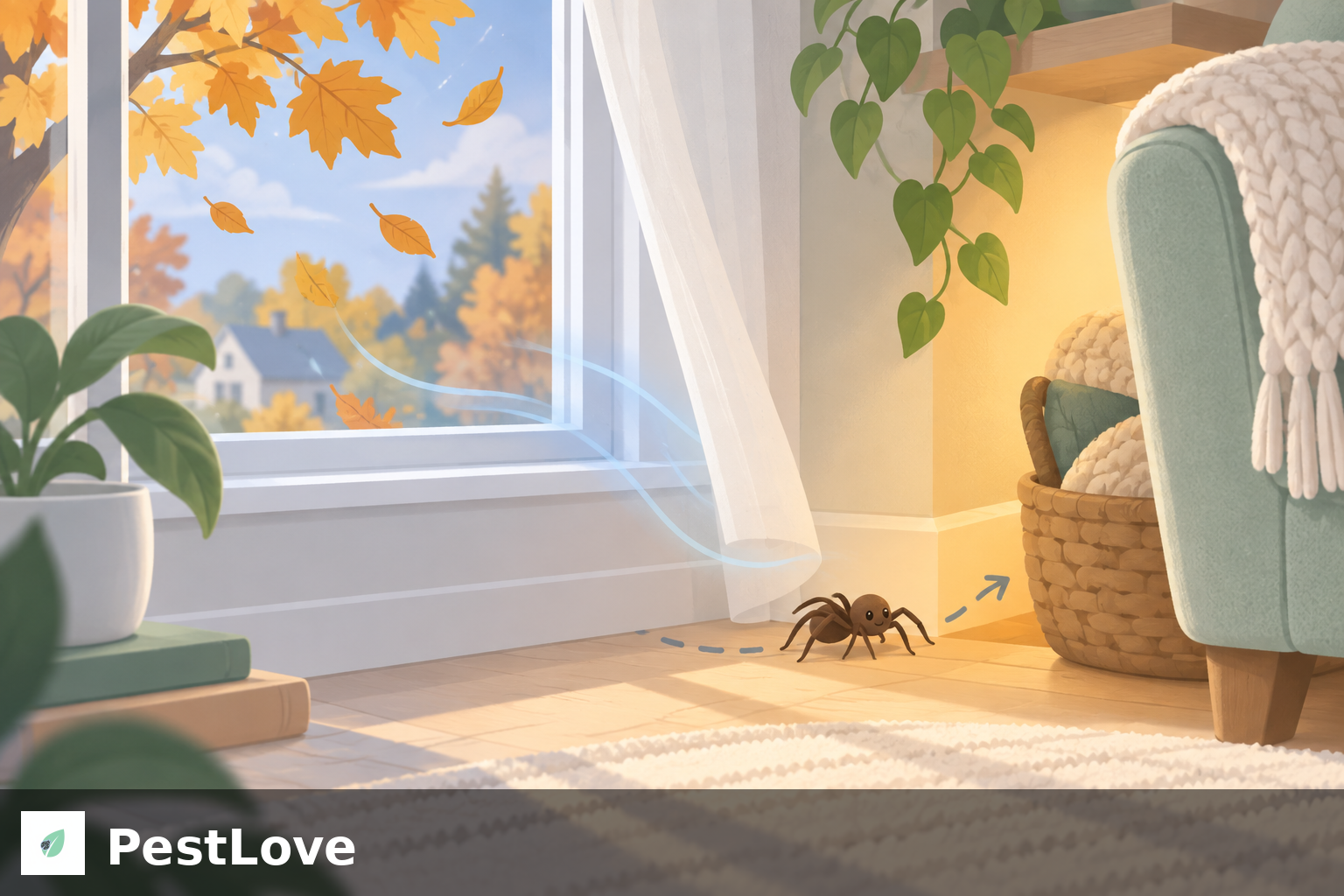
Why autumn brings more spider sightings
A spider crossing a floor in autumn has not necessarily entered to escape cold weather. There is no single explanation that applies to every species or temperate region. Species biology, local weather, building access, and the number of insects indoors all affect when spiders become noticeable.
In Britain, mature male house spiders in the genera Tegenaria and Eratigena are commonly seen during autumn when they leave their webs to search for females. The Natural History Museum reports that they may enter living areas through open windows, chimneys, and gaps beneath doors. UC Statewide IPM describes a similar reproductive pattern among some North American hunting spiders: mature males wander while searching for females and may enter buildings accidentally.
Autumn sightings can therefore reflect several processes:
- Reproductive movement: Adult males of some species travel while searching for females, making them more visible than web-bound spiders.
- Existing indoor populations: House spiders, cellar spiders, and cobweb spiders may already occupy quiet parts of a building. Movement into occupied rooms makes them easier to notice.
- Accidental entry: Spiders can pass through cracks, door gaps, poorly sealed screens, and other openings. They may also arrive on plants, firewood, boxes, or other stored items.
- Available prey: UC Statewide IPM notes that buildings containing more insects are more likely to support spiders.
- Local conditions: Weather can alter spider activity, but its effect depends on the species. UC Statewide IPM, for example, reports that some burrow-living spiders wander when wet conditions force them from their burrows.
What the sighting can reveal
The location and behavior of a spider provide useful evidence. One roaming spider near an exterior door suggests a different problem from occupied webs appearing repeatedly in an indoor storage area.
- A spider running across the floor: It may be a hunting spider or a mature male searching for a mate. Roaming alone does not show that a breeding population is established indoors.
- An occupied web containing prey: This confirms that the spider has found a usable web site and that arthropod prey is available.
- A dust-covered web: UC Statewide IPM describes a dusty indoor web as an old web that is no longer being maintained by a spider. Removing old webs makes new activity easier to detect.
- Repeated activity in storage: Inspect boxes, shelving, wall-floor junctions, clutter, and incoming goods. These areas can provide hiding places and undisturbed web sites.
- Spiders near windows or exterior lights: Outdoor lighting can attract insects, which in turn can attract spiders. Where practical, placing lights away from doors and windows may reduce this concentration.
Color, body size, or one marking may not be enough for reliable identification. UC Statewide IPM warns, for example, that the violin-shaped marking associated with recluse spiders is not always distinct and should not be used alone. Distribution, eye arrangement, body structure, web type, and a clear photograph can all help. Seek local expert identification when the species could affect safety or treatment decisions.
An IPM response for homes
Integrated Pest Management, or IPM, combines identification, monitoring, prevention, and proportionate control. The US Environmental Protection Agency notes that seeing one pest does not always mean control is required. The response should reflect the species, location, frequency, and risk of the sightings.
- Remove individual spiders safely: If there is no reason to suspect a medically important species, place a clear container over the spider, slide stiff card underneath, and move it without direct contact. Vacuuming is another option for unwanted spiders and webs.
- Inspect entry points: Check door thresholds, window frames, screens, foundation joints, vents, pipe penetrations, and attached garages. Repair screens and close suitable gaps.
- Reduce hiding places: Remove unnecessary clutter. Keep stored boxes closed and, where practical, off the floor and away from walls.
- Manage the perimeter: Remove accumulated debris and leaf litter beside the foundation. Store firewood away from the building and trim vegetation touching the structure.
- Reduce insect prey: Address insect activity and the food, water, waste, or lighting conditions supporting it. Effective screening can limit both spiders and their prey.
- Monitor recurring activity: Place sticky traps along walls or near suspected openings where children and animals cannot reach them. Record each trap's location and inspection date so captures can guide repairs. Traps should support inspection rather than replace exclusion and housekeeping.
Spiders prey on insects and other arthropods, so complete elimination is neither a realistic nor necessary goal in most settings. A more useful objective is to reduce repeated activity in occupied or sensitive areas.
Priorities for commercial buildings
Hotels, restaurants, and warehouses can apply the same IPM framework with thresholds suited to each operational area. A facility should document where spiders occur and direct corrective work toward the affected zone.
- Map observations: Record the date, precise location, web or roaming behavior, likely entry point, and corrective action. Keep photographs when identification is uncertain.
- Inspect doors during normal use: Loading doors, staff entrances, dock areas, and utility penetrations may expose gaps only while equipment or doors are operating.
- Review exterior lighting: Where safety and operational needs permit, avoid concentrating light and flying insects immediately beside entrances.
- Check incoming items: Inspect plants, firewood, boxes, and equipment that have been stored outdoors.
- Maintain inspectable storage: Keep stock orderly, remove unused packaging, and clean away old webs so fresh activity can be recognized.
- Compare pest records: Spider activity near fly, moth, ant, or cockroach captures may indicate that prey management also needs attention.
When pesticides may be appropriate
Routine broadcast spraying is not a proportionate first response to occasional spiders. UC Statewide IPM reports that pesticide control is difficult and temporary unless it is accompanied by housekeeping. EPA IPM guidance places broad, non-specific spraying after monitoring, prevention, and less risky controls.
If recurring activity continues after entry points, hiding places, and prey have been addressed, obtain an accurate identification before selecting any pesticide. Use only a product whose label covers the intended pest and application site. Follow every label direction and restriction, including instructions concerning food, children, animals, protective clothing, and re-entry. Local requirements may differ. A qualified pest management professional can assess persistent activity or a suspected medically important species.
Spider safety
Most spiders are not a serious threat to people, but risk varies by species and region. Avoid handling an unidentified spider with bare hands. Wear gloves when moving firewood, boxes, or clutter from undisturbed areas.
First-aid advice is also species-specific. Healthdirect Australia treats a suspected funnel-web or other big black spider bite in Australia as a medical emergency and provides different instructions for redback and other spider bites. Those Australian instructions should not be assumed to apply to every species or country.
After a suspected bite, use current guidance from the local emergency service, poison center, or medical provider. Seek urgent help for a known or suspected medically important spider bite, severe pain, breathing difficulty, collapse, worsening symptoms, or other signs of a serious reaction. Do not attempt to capture a suspected dangerous spider if doing so would create another exposure.
Frequently asked questions
Why do I notice more spiders indoors in autumn?
In Britain, mature male house spiders (Tegenaria spp. and Eratigena spp.) often leave their webs in autumn to seek females, making them easier to see. Existing indoor spiders, accidental entry, available insect prey and local weather can also affect sightings; an autumn spider has not necessarily come inside to escape the cold.
Does one spider crossing the floor mean an indoor infestation?
No. A roaming spider may be a hunting species, a male searching for a mate or an accidental entrant, and one sighting does not prove an established indoor population. Repeated occupied webs and recurring captures provide more useful evidence; a dusty web is usually old and no longer maintained.
How can I identify a spider without relying on one marking?
Use a clear photograph and consider local distribution, eye arrangement, body structure and web type together. A violin-shaped marking on a suspected recluse spider (Loxosceles spp.) may be indistinct and is not reliable by itself; seek local expert identification when species affects safety or treatment decisions.
What nonchemical steps can reduce recurring indoor spider activity?
Repair screens and close suitable gaps around doors, windows and other entry points, reduce clutter and insect prey, and keep stored boxes closed and, where practical, off the floor and away from walls. Where safety and operations allow, keep exterior lights from concentrating insects beside entrances. Sticky traps can help monitor activity if placed beyond the reach of children and animals, but they do not replace inspection and exclusion.
When should I consider pesticide treatment or professional help?
Routine broadcast spraying is not a proportionate response to an occasional spider. If activity persists after addressing entry points, hiding places and prey, identify the species before selecting a pesticide; use only a product labeled for the intended pest and site and follow its directions and local requirements. A qualified pest professional can assess persistent activity or a suspected medically important species.
What should I do after a suspected spider bite?
First aid depends on the species and country, so use current advice from your local emergency service, poison center or medical provider rather than applying another country’s instructions. Seek urgent help for a known or suspected medically important spider bite, severe pain, breathing difficulty, collapse, worsening symptoms or another serious reaction. Do not try to capture a suspected dangerous spider if that could expose anyone again.
Software for your business
Turn knowledge into a connected operation.
PestLove connects scheduling, field services, HACCP records, laboratory samples and reports. Every organization sees the tools relevant to its day-to-day work.
14-day free trial. No credit card required.
Related guides
All guides
How to Photograph a Spider Safely
A useful identification photo should show the spider clearly without requiring contact, capture, or disturbance. This guide explains the safest shooting sequence, th...
Yellow Sac Spider SOPs for Ontario Warehouses
Yellow sac spiders (Cheiracanthium mildei) are among the most common causes of verified spider bites in Ontario commercial buildings, and distribution centres offer...
Cluster Fly vs Cellar Spider: Chalet Attic Audits
Autumn overwintering audits protect Swiss chalet rentals from cluster fly swarms and cellar spider webbing before guests arrive. This guide compares both pests and o...