English
Drain Fly or Fungus Gnat? Inspect the Breeding Site
Drain flies and fungus gnats require different source-control measures, even though both favor damp organic material. Inspect drains, potting mix and hidden moisture before choosing a treatment.
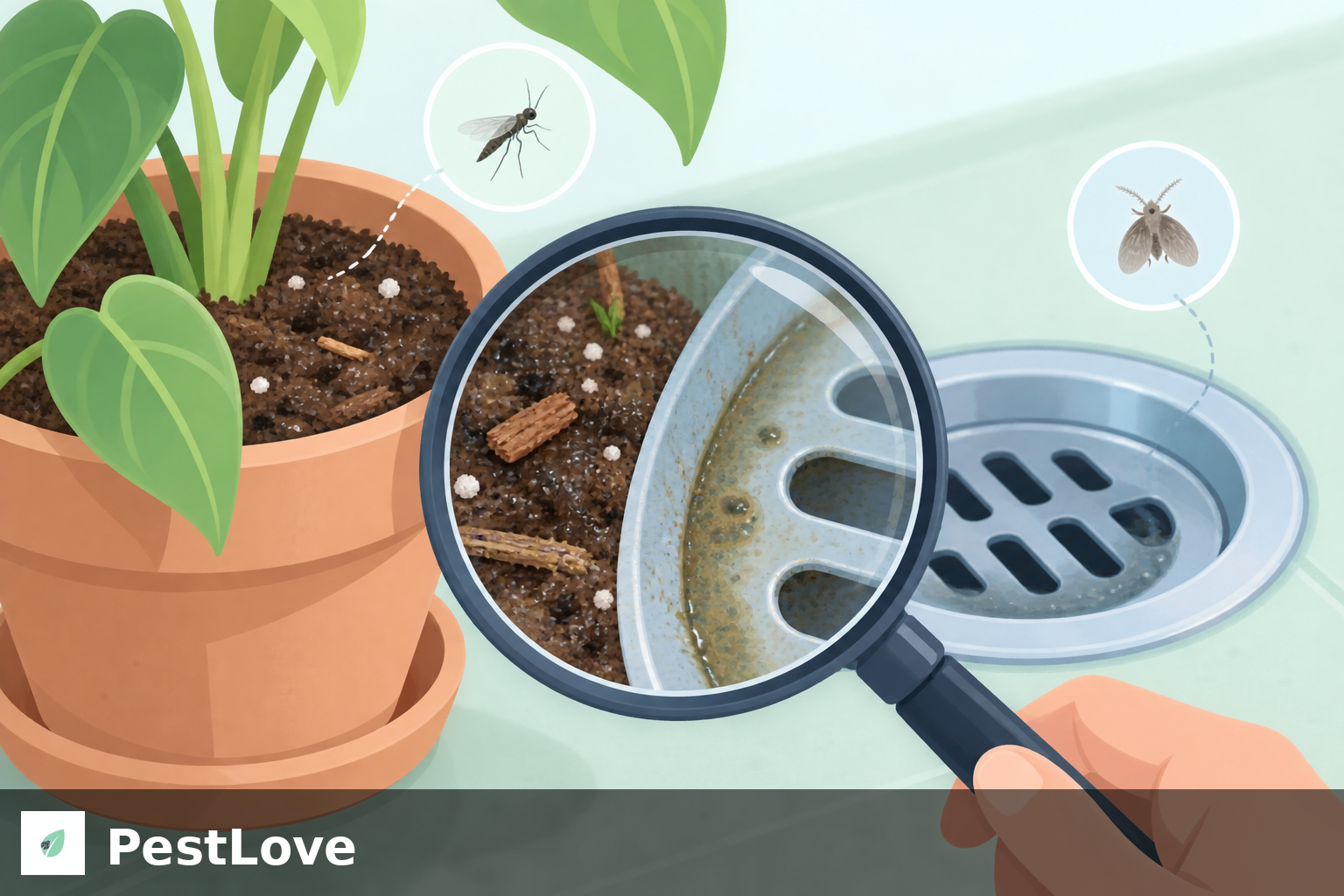
The short answer
A fuzzy, moth-like fly emerging from a drain is probably a drain fly, also called a moth fly, in the family Psychodidae. A slender, mosquito-like fly emerging from moist potting mix is more likely a dark-winged fungus gnat, commonly a Bradysia species.
The breeding site is usually more useful than the room where an adult was found. Fungus gnats often collect at windows after leaving a plant, while drain flies can emerge from condensate pans, wet refuse containers and plumbing leaks as well as drains. Identification by location also has limits: university extension guidance notes that fungus gnats can breed in drains containing moist organic debris. A drain emergence test therefore identifies an active source, but the captured adult may still require close examination.
Drain fly versus fungus gnat
| Diagnostic clue | Drain fly | Fungus gnat |
|---|---|---|
| Adult shape | Compact and conspicuously fuzzy, with broad wings that can look like a tiny moth | Slender and mosquito-like, with long legs and antennae |
| Wing clue | Hairy wings commonly held roof-like over the body | A distinct Y-shaped vein can be visible on the forewing under magnification |
| Typical larval site | Gelatinous organic film inside drains and traps, or another continuously damp site containing organic material | Moist, organic-rich growing medium, usually near the upper portion of a plant container |
| Other possible sources | Leaking or backed-up plumbing, dirty refuse containers, plant saucers, clogged storm drains and condensate pans | Decaying plant material and drains containing moist debris |
| Useful monitoring method | Cover a suspect drain with screen or cheesecloth and check for emerging adults | Use yellow sticky cards at the pot and inspect the growing medium for larvae |
| Primary correction | Remove the organic film mechanically and repair the moisture or plumbing defect | Correct excessive moisture, remove decaying material and improve growing-medium conditions |
Size can support an identification but should not decide it. University extension descriptions place common drain flies broadly between about 1.5 and 6 millimetres and common indoor fungus gnats near 3 millimetres. Species, posture and viewing conditions can make those differences unreliable without magnification.
Inspect the source before treating
1. Map where adults are actually appearing
Record the first location seen rather than where the fly eventually lands. Note nearby drains, plant containers, refrigeration or air-conditioning equipment, refuse storage, mop sinks and persistent dampness. Adults at a window reveal little about their origin because fungus gnats can disperse a short distance and collect around window frames.
In a larger building, divide the property into inspection zones. Give each drain and plant group a simple identifier, then record dates and observations consistently. This turns scattered sightings into a pattern that maintenance and pest management teams can investigate.
2. Test suspect drains
When a drain can be taken out of service, secure screen or cheesecloth over its opening and inspect it over the next several days. The cover should capture or reveal emerging adults without being pushed into the plumbing. Test multiple drains at the same time when the source is uncertain.
A positive emergence test proves that the drain is supporting flies. It does not, by itself, distinguish a psychodid drain fly from a fungus gnat or another small fly capable of using wet debris. Examine the captured insect for the fuzzy, broad-winged drain fly form. A slender specimen should be retained for professional identification if the distinction affects the control plan.
3. Test plant containers
Place a yellow sticky card close to the growing-medium surface rather than across the room. A concentration of slender gnats at one container makes that pot a strong suspect. A loose screen or cheesecloth enclosure around an individual plant can also help establish whether adults are emerging there without sealing the plant in an airtight covering.
Colorado State University Extension describes a second larval check: insert a roughly 6 millimetre slice or wedge of raw potato into the growing medium and inspect its underside after a few days. Fungus gnat larvae are translucent and wormlike with a dark head capsule. Remove the potato after inspection.
4. Inspect less obvious moisture
If drain and plant tests are negative, check accessible plumbing traps, leaks, sewer backups, refrigerator and air-conditioning condensate pans, wet refuse residue, clogged exterior drainage and plant saucers. Repeated activity from a wall, floor joint or area around a slab can indicate concealed moisture or damaged plumbing, but fly activity alone does not establish the location or severity of a defect.
Control the confirmed breeding site
If the source is a drain
Remove hair, food residue and the gelatinous film from accessible drain surfaces and traps with an appropriate drain brush and routine plumbing-cleaning procedure. A surface rinse or hot water alone may leave the film attached to the pipe. Correct drips, condensation and broken or leaking plumbing so the site does not remain suitable for development.
Do not combine drain-cleaning chemicals or improvise pesticide applications in plumbing. Follow the cleaner manufacturer's instructions and the facility's plumbing and chemical-safety procedures. A licensed plumber should handle suspected defects, inaccessible traps or wastewater problems.
Adult traps can support monitoring, but killing visible adults without removing larval material will not resolve the source. Existing adults may remain visible after cleaning, so repeat emergence checks and document whether captures decline.
If the source is potting mix
Allow the upper 2.5 to 5 centimetres of growing medium to dry between waterings when that is compatible with the plant's needs. Empty standing water from saucers, remove decayed roots and fallen plant material, and correct containers or media that remain chronically saturated. Degraded medium that holds excessive moisture may need replacement.
Yellow sticky cards help monitor adults but do not reach larvae in the growing medium. Products containing Bacillus thuringiensis subsp. israelensis, or beneficial nematodes such as Steinernema feltiae, can target fungus gnat larvae in appropriate settings. Availability, registration and permitted uses differ by country. Use only a product authorized and labelled for the plant and application site, or have a licensed pest management professional select and apply the treatment.
A source-first IPM decision
The US Environmental Protection Agency's integrated pest management framework emphasizes monitoring, accurate identification, prevention and selection of lower-risk controls before broader pesticide use. Applied to these flies, the decision is straightforward:
- Adults emerge from potting mix and match the slender form: manage the plant's moisture and organic material as a fungus gnat source.
- Adults emerge from a drain and are fuzzy with broad wings: remove drain biofilm and correct the moisture source.
- Adults emerge from a drain but look slender: keep the drain on the correction list, but obtain an identification because fungus gnats can also develop there.
- No tested site produces adults: expand the inspection to condensate, wet refuse, exterior sources and concealed plumbing rather than repeatedly treating adults.
Commercial inspection priorities
Restaurants, hotels, warehouses and managed properties should use a documented zone inspection rather than treating every drain automatically. Record the drain or planter identifier, adult captures, organic buildup, moisture defects, cleaning performed and follow-up result. Standardized records make recurring sources and missed maintenance easier to detect.
- Restaurants and cafes: inspect floor drains, bar sinks, dishwashing zones, beverage stations, refuse areas, mop storage and equipment condensate. The commercial kitchen sanitation guide provides a more detailed drain-focused program.
- Hotels: include guest bathrooms, housekeeping areas, laundry drains, indoor landscaping and condensate equipment. Visible adult control should not replace investigation of the source.
- Warehouses and offices: check staff kitchens, washrooms, floor drains, indoor plants and HVAC condensate, including areas that remain unused for long periods.
- Atriums and interior landscapes: inspect irrigation practices and drainage alongside plumbing. The guide to fungus gnat and drain fly control in atriums addresses this mixed-source setting.
Monitoring devices should be placed where they cannot contact food, contaminate work surfaces or interfere with operations, and their use should follow local requirements and the site's pest management plan.
When professional investigation is warranted
Seek a licensed pest management professional when identification remains uncertain, activity is widespread, or a serious infestation continues after confirmed breeding sites have been corrected. Persistent emergence near slabs, walls, wastewater lines or inaccessible plumbing also warrants assessment by a qualified plumber. Food service, healthcare, hospitality and other sensitive facilities should escalate recurring fly activity promptly under their site-specific sanitation and pest management procedures.
Frequently asked questions
How can I tell a drain fly from a fungus gnat?
A drain fly (Psychodidae) is compact and fuzzy, with broad, hairy wings often held roof-like; a dark-winged fungus gnat (commonly Bradysia spp.) is slender, mosquito-like, and has long legs and antennae. Check where adults emerge, but do not identify them by location alone because fungus gnats can also breed in drains.
How can I confirm that a drain is breeding small flies?
When the drain can be taken out of service, secure screen or cheesecloth over its opening and check for emerging adults over the next several days. A positive test identifies an active drain source, but examine the adults: fuzzy drain flies (Psychodidae) and slender fungus gnats (including Bradysia spp.) can both use wet debris.
How can I check whether a plant container is producing fungus gnats?
Put a yellow sticky card close to the growing-medium surface and inspect the container for adult fungus gnats (commonly Bradysia spp.). For larvae, insert a roughly 6 mm slice or wedge of raw potato into the medium and check its underside after a few days; fungus gnat larvae are translucent and wormlike with a dark head. Remove the potato after inspection.
What should I do when a drain is the confirmed breeding site?
Brush away the organic film from accessible drain surfaces and traps, and correct leaks or other moisture defects; hot water or a surface rinse alone may leave the film in place. Do not mix drain-cleaning chemicals or improvise pesticide applications in plumbing; follow product and facility safety instructions and use a licensed plumber for suspected defects or inaccessible traps.
What should I do when fungus gnats are breeding in potting mix?
When suitable for the plant, let the top 2.5 to 5 cm of growing medium dry between waterings, empty standing water from saucers, and remove decaying plant material. Yellow sticky cards monitor adults, while an authorized and labelled Bacillus thuringiensis subsp. israelensis product or appropriate Steinernema feltiae nematodes can target larvae; permitted uses vary by country, so check the product label or ask a licensed pest management professional.
When is professional investigation needed for recurring small flies?
Seek a licensed pest management professional if identification is uncertain, activity is widespread, or a serious infestation persists after confirmed breeding sites have been corrected. Repeated emergence near a wall, slab, wastewater line, or inaccessible plumbing warrants assessment by a qualified plumber; sensitive facilities should promptly escalate recurring activity under their sanitation and pest management procedures.
Software for your business
Turn knowledge into a connected operation.
PestLove connects scheduling, field services, HACCP records, laboratory samples and reports. Every organization sees the tools relevant to its day-to-day work.
14-day free trial. No credit card required.
Related guides
All guides
Late-Summer Fly Control for Argentine Meat Plants
Argentina's late-summer heat drives blow fly and house fly pressure to its annual peak across frigoríficos, boning halls, and cold chain docks. This guide outlines a...
Fungus Gnat & Drain Fly Control in Bogotá Atriums
Bogotá's high-altitude rainy seasons drive fungus gnat and drain fly emergences in hotel atriums, where planters and floor drains create ideal breeding habitat. This...

Phorid Fly Control Under Nigerian Hotel Kitchens
Phorid flies breeding beneath hotel kitchen floors are a source-driven problem that spraying cannot solve. This guide explains identification, breeding biology, floo...