English
Wasp Nest or Honey Bee Colony? Read the Flight
Repeated traffic identifies an active entrance, not the occupant. Look for pollen loads, body hair, trailing legs and visible nest material.
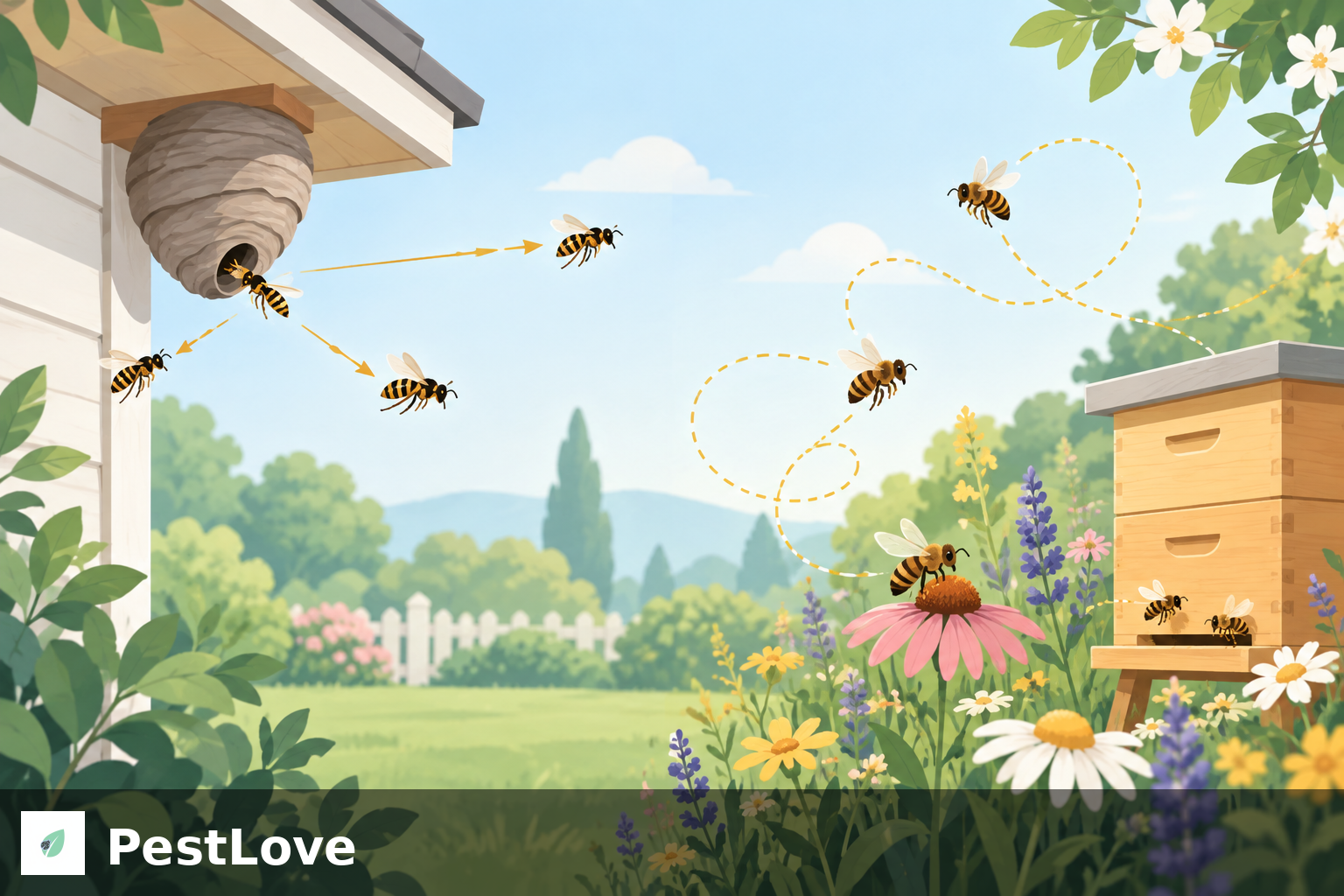
What the flight line tells you
Repeated arrivals and departures through one opening indicate that insects are using a nest or colony inside the cavity. The amount of traffic does not identify them. Honey bees and yellowjackets can both use hollow trees, wall voids and other enclosed spaces. Bumble bees can also nest in wall voids.
The clearest flight-based clue is pollen carried by returning workers. Honey bee workers, Apis mellifera, can pack pollen into rounded clumps on their hind legs. Returning bees with yellow pollen on their legs support a bee colony, but bumble bees (Bombus spp.) also carry packed pollen and can nest in wall voids. Confirm honey bees from additional features or a qualified identification. Absence of visible pollen is not proof of a wasp nest because not every returning honey bee carries pollen.
Observe without disturbing the entrance
Watch from outside the flight path and remain well away from the opening. Do not block the entrance, strike the surrounding surface or climb toward the nest. Use binoculars or camera zoom when the insects are too small to identify safely.
- Keep children, pets, guests and unprotected workers away.
- Record the exact opening used by arriving and departing insects.
- Photograph insects when they pause near the entrance, if this can be done without moving closer.
- Look for pollen on several returning insects rather than relying on one blurred sighting.
- End the observation if insects begin approaching or contacting the observer.
Do not attempt to provoke a defensive response. Social bees and wasps are most likely to sting when their colony or nest is disturbed.
Flight and nest clues compared
| Clue | Honey bee colony | Social wasp nest |
|---|---|---|
| Entrance traffic | Workers repeatedly leave and return through a cavity opening. | Cavity-nesting yellowjackets and some paper wasps can create a similar two-way flow. |
| Returning pollen | Some workers carry compact pollen clumps on their hind legs. Repeated sightings support a bee identification, but do not distinguish honey bees from bumble bees. | Visible pollen clumps on the hind legs do not fit the usual flight activity of yellowjackets or paper wasps. |
| Body surface | Honey bees are hairy and generally orange, yellow-orange or brownish in appearance. | Yellowjackets and European paper wasps have comparatively smooth bodies and brighter contrasting markings. |
| Leg position | Look at the hind legs for pollen rather than using leg position alone. | Long hind legs trailing below the body support identification as a paper wasp, particularly a European paper wasp. |
| Visible nest material | Honey bees construct wax comb. | Paper wasps make exposed paper comb without an outer envelope. Yellowjacket and hornet comb is enclosed in a paper envelope, although a cavity can hide it. |
| Foraging activity | Workers gather nectar and pollen from flowers. | Social wasps commonly hunt insects. Some yellowjackets also visit rubbish, meat and sweet foods. |
| Colony duration | An established honey bee colony can persist from one year to the next. | In temperate climates, social wasp colonies are generally annual. Fertilized females overwinter and begin new colonies in spring. |
How to interpret common observations
A busy opening in a wall, tree or the ground
This locates an active entrance but does not identify the insect. Honey bees and yellowjackets can both occupy hidden cavities. Traffic counts are not a dependable substitute for seeing the insects clearly.
Pollen arriving at the entrance
Repeated sightings of paired pollen clumps on the hind legs are strong evidence of bees, but cannot alone distinguish honey bees from bumble bees. A zoomed photograph can reveal this feature without requiring anyone to catch an insect.
Long legs trailing in flight
This posture points toward a paper wasp. Paper wasps are more slender than yellowjackets and may build exposed nests under overhangs. Some also use pipes, wall spaces and other cavities, so their paper comb may not be visible.
A cluster away from an entrance
A mass of honey bees resting on a branch, fence or other exposed object may be a temporary swarm while scout bees search for a permanent site. This differs from an established colony with regular traffic through a cavity. Keep people and animals away and contact a beekeeper who collects swarms if assessment or removal is needed.
Wasps around food or waste
Yellowjackets may forage around rubbish, meat and sweet foods. Their presence at a bin or outdoor table does not prove that the nest is nearby. Treat it as foraging activity unless a specific entrance is found.
A practical identification sequence
- Locate the destination. Confirm that insects repeatedly enter one opening rather than merely visiting flowers, water or food.
- Inspect returning insects. Look for paired pollen clumps on the hind legs.
- Review a still photograph. Compare body hair, coloration, body shape and leg position.
- Check visible construction. Vertical sheets of wax comb support honey bees; wax alone does not distinguish them from bumble bees. Open paper cells support paper wasps. A paper envelope supports a yellowjacket or hornet identification.
- Record without disturbing. Save photographs, the entrance location and observations for the person performing the identification.
- Refer unresolved cases. Send clear photographs to a university extension service, local beekeeping organization or qualified pest professional before considering control.
This follows an Integrated Pest Management approach. The US Environmental Protection Agency recommends monitoring and accurate identification before deciding whether control is needed. It also recommends considering effective, lower-risk controls before escalating to broader pesticide use.
What to do after identification
If the traffic belongs to honey bees
Do not begin by spraying or sealing the entrance. A structural colony may include bees, wax comb and stored honey inside the void. Effective removal can require opening the cavity, removing the bees and comb, and closing the entry points after the colony is gone. Comb left inside can melt and stain building materials.
If the entrance is remote from routine human and animal activity, leaving the colony in place may be an option. If it is inside an occupied building or beside a busy route, consult a specialist experienced in structural honey bee removal. Qualifications, pesticide rules and available services vary by jurisdiction.
If the traffic belongs to wasps
A nest that is unlikely to be disturbed may be left in place and monitored. In temperate regions, social wasp colonies are generally abandoned at the end of the season. A nest beside a doorway, walkway, play area, work platform or other frequently used space presents a greater sting risk.
Keep people away from an active cavity entrance and obtain professional advice before treatment or exclusion. Hidden, elevated and ground nests can be difficult to locate and may be vigorously defended if disturbed.
Response on a commercial property
Hotels, restaurants, warehouses and managed residential properties should treat an unidentified flight line as a temporary access problem until the insect and entrance have been assessed.
- Control access: reroute guests, deliveries and staff without approaching or blocking the opening.
- Pause nearby work: stop mowing, hedge cutting, facade work, ladder use or equipment movement that could disturb the nest.
- Manage attractants: cover food and drinks, clean spills and keep waste containers closed where yellowjackets are foraging.
- Document the site: record the entrance, nearby occupied rooms, doors, air intakes and any indoor sightings.
- Use suitable expertise: contact a qualified pest professional for a wasp nest or a structural honey bee removal specialist for an established bee colony.
When a sting is an emergency
Stinging insects can cause anaphylaxis, a serious allergic reaction that may become life-threatening. Warning signs include trouble breathing or swallowing, swelling of the lips, tongue or throat, a weak pulse, dizziness or fainting. Call the local emergency number immediately for a serious allergic reaction. If an epinephrine auto-injector is available, use it promptly according to its instructions or the person's prescribed emergency plan, and seek emergency medical care.
Bottom line: a flight line finds the entrance. Repeated pollen-bearing return flights strongly support bees over wasps, but do not identify honey bees by themselves. Body hair, trailing legs and nest material can refine the identification. When the evidence conflicts or the entrance affects occupied space, keep people away and obtain a qualified assessment.
Frequently asked questions
What does pollen at a busy cavity entrance tell me?
Repeated traffic identifies an active entrance, not the occupant. Honey bee (Apis mellifera) workers may carry compact pollen loads on their hind legs, but bumble bees (Bombus spp.) also do and can nest in wall voids; repeated loads support a bee colony rather than social wasps (Vespidae), not honey bees specifically. No visible pollen does not prove a wasp nest.
Which flight and nest features help identify paper wasps or yellowjackets?
Paper wasps (Polistes spp.) often trail long legs in flight and build open paper comb without an outer envelope. Yellowjackets (Vespula spp., Dolichovespula spp.) have comparatively smooth bodies and build comb enclosed by a paper envelope, although a cavity may hide it. Use photographs and several clues rather than leg position alone.
How can I observe an active entrance safely?
Stay well outside the flight path and use binoculars or camera zoom rather than moving closer. Do not block the entrance, strike the surface or provoke a defensive response; end the observation if insects approach or contact you. Keep children, pets, guests and unprotected workers away, and send clear photographs to a qualified expert if identification remains uncertain.
What should I do with a confirmed honey bee colony or wasp nest?
A honey bee (Apis mellifera) colony away from routine human and animal activity may be left in place, but one inside an occupied building or beside a busy route warrants a structural bee-removal specialist; do not begin by spraying or sealing its entrance. A social wasp (Vespidae) nest unlikely to be disturbed may be monitored, while one near a doorway, walkway or play area poses greater sting risk. Keep people away from active cavity entrances and obtain professional advice before treatment or exclusion.
What should a business do while a flight line remains unidentified?
Treat it as a temporary access problem: reroute guests, deliveries and staff without approaching or blocking the opening, and pause nearby work that could disturb the nest. Where yellowjackets (Vespula spp., Dolichovespula spp.) are foraging, cover food and drinks, clean spills and close waste containers. Record the entrance and any indoor sightings for the qualified specialist who assesses the site.
When is a sting an emergency?
Trouble breathing or swallowing, swelling of the lips, tongue or throat, a weak pulse, dizziness or fainting after a sting may signal anaphylaxis. Call the local emergency number immediately for a serious allergic reaction; if an epinephrine auto-injector is available, use it promptly according to its instructions or the person's prescribed emergency plan and seek emergency medical care.
Software for your business
Turn knowledge into a connected operation.
PestLove connects scheduling, field services, HACCP records, laboratory samples and reports. Every organization sees the tools relevant to its day-to-day work.
14-day free trial. No credit card required.
Related guides
All guides
Wasp Nest Surveys for Kenyan Lodge Verandas
Mud daubers and paper wasps colonise the sheltered eaves, rafters and thatch of Kenyan safari lodge verandas, creating guest safety and reputation risks. This guide...
Late-Summer Wasp Control for Danish Bakeries
Common wasps (Vespula vulgaris) shift from protein foraging to sugar-seeking in August and September, turning Danish bakeries, konditorier and café terraces into hig...
Paper Wasp Nest Audits for Coffee Fincas
Paper wasps (Polistes spp. and Polybia spp.) nest heavily in coffee shade trees, drying patios, and guest structures across Colombia's Eje Cafetero. This guide outli...